The Rise and Rise of the Superego
Published on 20 April 2026
A common argument from feminists is that medical research is skewed towards male-dominated diseases. There’s some research to back this up, although I have qualms with how they use DALYs in their methodology (surely no-one would suggest we fund diseases which impact black people less because they live less long anyway).
Here’s a table from Art Mirin, showing diseases which disproportionately impact men and their level of NIH funding. So based of 2019 funding, HIV/AIDS is over-funded by a factor of 17.8 relative to its benefit (based off a simple regression), and all but one condition is over-funded.
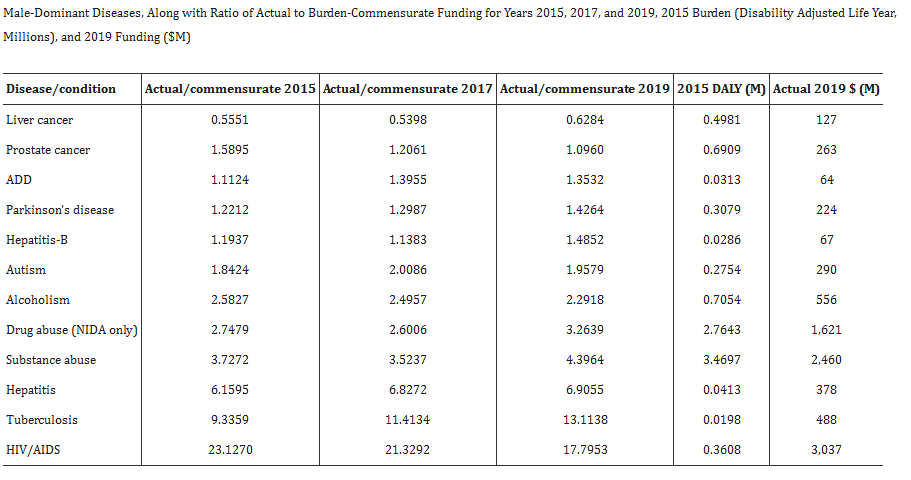
An astute reader can probably see where I’m going with this, especially if they’re aware that TB mostly impacts the immunocompromised in the West and that the different varieties of Hepatitis are caused by such things as needle sharing, alcoholism and STDs. The most overfunded gender-neutral condition in that paper is infertility and the most overfunded female-dominated condition is STDs/Herpes. While I think he may not have done a great job with categorizations, similar findings are made by other researchers.
Contrary to narratives that this is the cis-hetero patriarchy in action, it becomes immediately obvious eyeballing the data in this paper and others that we’re over-subsidizing research into diseases which are caused by lifestyle decisions. Men are disproportionately benefitting from medical research because they’re more likely to be degenerates. It’s no coincidence that two of the biggest medical breakthroughs of the 21st century are PrEP and GLP-1 drugs; the telos of the modern West is to protect people from the consequences of their own actions.
A small digression. My view is that a civilization reaches its apogee when the negative tendencies (which have been growing stronger) equal that of the positive tendencies. A turning point in the overall trajectory of a society in no way implies that there was a reversal in any of the underlying trends; it might just be that’s the time at which the negative tendencies begin to outweigh the positive ones. To put it in a simple metaphor: a rocket doesn’t begin returning to earth because gravity has started acting on it. Gravity was always acting on it. But at a certain point gravity more than offsets the lift generated by the chemical propellant.
Many developments have both positive and negative effects. So for instance classical writers often claim that an accumulation of material wealth (good) will in turn lead to vanity, class envy, a loss of social cohesion etc. This is true especially of technology, which usually improves over the course of a civilization, augmenting its power, even as it undermines many of the qualities that said civilization rests on (personal virtue, say).
What is unusual about the development of these pharmaceuticals which further enable debauchery is not so much that they might have downsides by perpetuating behaviour that is harmful, but that it seems to be the point of modern “progress”. This is so common that we almost habitually equate progress with further degradation; start-ups in Silicon Valley with pernicious side-effects are overfunded precisely because it makes them seem of the future.
The left became supportive of drug abuse and sexual promiscuity in the 60s, ostensibly as a form of liberalism whereby people could choose any lifestyle which did not impinge upon others. This characterization is insufficient; rather I’d argue the modern left abhor people being subjected to standards of any sort, regardless of the harm caused to others or society more broadly. On this basis they oppose the criminal justice system, sexual mores, academic standards, beauty standards, gender norms, psychometric testing, cultural integration of immigrants, etc. Today even standards of competence at work are attacked as “ableism”.
My admittedly speculative psychological explanation is that many people on the left today feel, in their personal lives, that it’s a struggle to meet the standards imposed upon them. In reaction to this they support a politics which seeks to overturn all established standards and conventions in the vain hope it will alleviate their own insecurities.
This explains the well-known paradox that the norm-destroyers are more likely to abide by said norms, because they are more psychologically predisposed to worry about them in the first place. So the pro-crime criminologist is among those least-likely to commit crimes, the most educated strata of society most vociferously oppose standardized testing in schools, democrats are thinner than republicans but also campaign for more acceptance of obesity, and so on. It also explains the trend of young women herding to the left, as they always and everywhere more keenly feel either real or perceived societal expectations.
While previous writers have adumbrated this idea before, I’ve seldom seen discussed why it’s getting worse over time. If the abolition of repressive norms has been the sine qua non of the new left since the 60s, how are people not already somewhat liberated? The answer is simple if counter-intuitive: when you destroy common expectations they’re replaced by imagined ones which might be more onerous than the original ones.
To make this more concrete with an example, consider that school students used to have their bodies measured in various ways as well as their fitness levels. Naturally this practice was halted in the latter part of the 20th century because it was thought that it led to invidious comparisons and psychological harm. But I’m suggesting the reverse: remove the external and quite reasonable standard, then many students will become obese but others will develop eating disorders and become obsessed with their body-weight. Each individual’s standard is no longer anchored to the external standard.
Unrealistic self-standards are not the only reason this is harmful. The internalization of norms which were formerly provided by one’s social setting itself leads people to become more neurotic. There is a parallel here with the classic Žižek parable. An authoritarian parent might force their child to visit the child’s grandmother, while a modern permissive parent might say “you know how much your grandmother loves you! But nevertheless, I do not want to force you to visit her”. In practice this not only requires the child to visit the grandmother, but puts the onus on the child to force themselves to do so.
The lack of social coercion to do what is best is exacerbated by other incentives also becoming more perverse over time. Consider a young person today. On the one hand they can choose various highly convenient short-term dopamine hits: video games, pornography, substance abuse, etc. On the other hand the “good” behaviour has uncertain and distant rewards. If you study hard tonight you might get better grades which might imperceptibly improve your chance of a decent job after graduating. If you hit the dating apps you might have a 0.0x% chance of meeting your future partner after a grueling dating process, although more likely you’ll meet nothing but rejection. If you apply for jobs… you get the idea. We are not evolved to have such an extreme time-preference and so we must find strategies to force ourselves to do these tasks.
One often hears people say when dieting they just fat-shame themselves in front of a mirror to keep their diet on track. Modernity makes people fat through advances in food technology and jobs which force them to be sedentary, and then denies them even the motivation they might have got if their friends had fat-shamed them. The solution, self-shaming, is almost certainly psychologically detrimental but becomes a necessary disciplinary tool.
In addition to exaggerating the shame of failure, another motivational strategy is to magnify the rewards from success. Those who don’t want to fall into the abyss like many of their peers may concoct grandiose visions of their future to motivate themselves. This results in the perpetual self-improver, those who abstain from almost all pleasure in an indefinite loop of self-improvement (gym, study, work) with no end in sight. Often these plans border on delusional (e.g. expecting a slightly better bench-press to magically procure a girlfriend), and these individuals spend their lives preparing for a future which will never arrive.
Those who are more neurotically inclined to impose high standards upon themselves, through one method or another, will tend to succeed more in schools and in the workforce, with this advantage becoming more pronounced the more public standards are stripped back. They disproportionately end up in the privileged classes and then use this position to further erode public standards of behaviour, wrongly believing they are the source of their neuroses. We are trapped in this positive feedback loop.
In the long run I predict this means society will continue bifurcating into two groups. Those who capitulate to short-term pleasure seeking in the absence of external constraints, and a much smaller and highly neurotic group of strivers who all end up in therapy and suffer from mental illness and anhedonia. The latter feel unfree due to their obsessive self-monitoring and self-critique, but this is a response to the very anomie which they perpetuate and further intensify in the false belief it will liberate them.
At our current level of technological development we are still dependent on individuals making good decisions. The ongoing crusade to protect individuals from the consequences of their own actions is anti-civilizational insofar as it further encourages poor behaviour. This remains true even if in some isolated instances we accomplish it with few downsides, as in the case of the pharmaceutical solution to obesity.