<?xml version="1.0" encoding="utf-8"?><feed xmlns="http://www.w3.org/2005/Atom" ><generator uri="https://jekyllrb.com/" version="3.10.0">Jekyll</generator><link href="https://baazaa.github.io/feed.xml" rel="self" type="application/atom+xml" /><link href="https://baazaa.github.io/" rel="alternate" type="text/html" /><updated>2026-05-17T14:03:16+00:00</updated><id>https://baazaa.github.io/feed.xml</id><title type="html">A Monitor Darkly</title><subtitle>Random musings...</subtitle><entry><title type="html">Layoffs</title><link href="https://baazaa.github.io/2026/05/17/layoffs.html" rel="alternate" type="text/html" title="Layoffs" /><published>2026-05-17T09:00:00+00:00</published><updated>2026-05-17T09:00:00+00:00</updated><id>https://baazaa.github.io/2026/05/17/layoffs</id><content type="html" xml:base="https://baazaa.github.io/2026/05/17/layoffs.html"><![CDATA[<h1 id="layoffs-and-ai">Layoffs and AI</h1>

<p><span class="publish-date"> Published on  17 May 2026</span></p>

<p>I know no-one who has been fired due to underperformance. Outside of some start-up hires, I know no-one who has been laid-off due to legitimate budgetary concerns. I do, however, know a great number of people who’ve been laid during the recurrent mass lay-offs which convulse every bureaucratic organisation on an increasingly regular basis.</p>

<p>These mass layoffs are poorly targeted; people are let go regardless of job performance or how much harm it causes the employer. I’ve seen people laid-off who are critical to major projects which immediately becomes a crisis. Insofar as there’s any targeting at all, it’s usually based off demographics (especially age). I suspect a major reason there isn’t more targeting (say to protect the jobs of important workers) is that the decisions are made by senior managers, often with aid from management consultants, who’ve only a vague notion of what anyone in the organisation does.</p>

<p>Various specious reasons will be cited for the layoff, usually involving a change in the operating conditions of the organisation. These seldom stand-up to much scrutiny. For instance some of the biggest layoff sectors in my country are tech, banks and universities. The latter two are not especially buffeted by changing circumstances. A simple thesis that explains the pattern is that any sector which draws large economics rents will develop a large bureaucracy; and layoffs are fundamentally a bureaucratic pathology as I’ll outline below.</p>

<p>While many consider the human costs of these reorganisations, I’m more interested in how inefficient they are. No-one ever points out how wasteful they are.</p>

<p>For starters, hiring is very expensive. For skilled positions it takes months and can involve more than a dozen stages (ideally the cheap stages are first and only a few candidates are assessed in the latter stages). Recruiters can also take a slice (say 20-30% of first year salary) if they sourced the final candidate. Then there is a remarkable amount of administrative overhead in the modern organisation (payroll, IT, healthcare and pension entitlements, etc.). There’ll be onboarding which takes time from existing productive employees, while the new starter will take months to ramp up their own contributions as they get familiar with the role. Some fraction of new-starters will be complete disasters, so the process will need to be repeated.</p>

<p>Firing is also costly, although less-so unless there’s legally-mandated large redundancy payments. There is again a lot of administrative overhead. Even in a jurisdiction like the US you might looking at 60 days of notice during which the workers will not be doing much work.</p>

<p>In addition to the direct costs above, there’s also second-order effects. For instance it’s widely noted that large tech companies have adopted ‘best practice’ which is incredibly laborious, but makes it easier to cope when workers leave (e.g. through meticulous documentation, testing, etc.) Start-ups with low-attrition can be several times more productive because they don’t need to optimise for ‘how do I keep the project going when a fraction of the crucial workers were fired for no reason’.</p>

<p>While there’s no widely-acknowledged figure for what the cost of all this is (some HR departments no doubt have costed it, but not made it public), it’s plausible to estimate that a hire + fire has a deadweight loss of around 50%-100% of the yearly salary. This is one reason why you’ll find that no well-run company hires workers whose contribution to revenue will be close to break-even, because the overheads will make such a hire a net-negative (median firm-level tenure for young skilled professionals is only around 3 years)</p>

<p>So we have to ask ourselves, why do organisations engage in endless cycles of over-hiring and then mass-layoffs?</p>

<p>One thing to note is that this behaviour was normalised in somewhat different historical circumstances. When ‘Neutron Jack’ (so-named because he eliminated all the workers while leaving the buildings intact) was firing everyone in the 80s there was a coherent narrative behind it. The companies had over-hired because they had been less-competently managed by Jack’s predecessors. He was fixing the problem of organisational bloat that others had created.</p>

<p>The first wave of mass redundancies can thus be plausibly be justified on the basis that it was a new paradigm of management, creating share-holder value by running leaner organisations. I make no assertion as to whether this was empirically true or not, merely that this makes sense as a story. The problem is that modern layoffs today reoccur repeatedly without changes to the C-suite or any long-lasting epiphany in how to run the company. The guys doing the mass-firing also did the over-hiring and they learn nothing from this process. I suspect, however, that the association between layoffs and ‘hard-nosed competent management’ persists even though it no longer stands to reason.</p>

<p>This association provides some cover for what’s happening, but doesn’t explain what’s causing it. The true motivation is actually pretty obvious to anyone who’s worked in these organisations. The only way to get quickly promoted through the managerial ranks in a modern organisation is to constantly move up during reorganisations. No-one can rise quickly enough if they wait for their boss to die or move on every time. Every ambitious manager who is seen as high-performing knows this, and lobbies internally for as many restructures as possible. As ambitious fast-rising managers are disproportionately influential within every organisation, they sooner-or-later get their way.</p>

<p>Now their main object isn’t layoffs per se, simply a restructure which justifies shuffling managers around. But they also need to rationalise this somehow to justify the chaos and confusion sown (restructures are typically resented by line-workers). Often the stated motivation will be something like this: ‘this new structure will be more efficient as it reduces duplication of work’ or ‘this restructure is necessary to leverage new technology which will make us more efficient’. These efficiency gains are demonstrated by the loss of headcount in the proposed restructure.</p>

<p>The second thing to understand is that during a reorganisation, managers who have more headcount will be advantaged when their reporting line merges with another.</p>

<p>These two facts: managers want reorgs which are most easily justified by cuts, and managers want to accumulate headcount between reorgs to increase their power, explains the bulimic nature of firm-level employment. Managers binge-hire when building out their bureaucratic fiefdom, then use this bloat to justify a purge during which time they can get use the number of their reports as leverage when absorbing other areas. That this is extremely wasteful is of little relevance, the losers are shareholders and laid-off employees but neither of them have a say in the decision.</p>

<p>This then brings me to my point and what prompted me to write this post. It is perfectly rational for AI companies to spruik that their technology destroys jobs. That’s part of the value-proposition for any manager considering invest in AI. The pitch is: ‘if you invest in AI your name will be attached to AI, and you can use AI to push through multiple restructures which will catapult AI-aligned managers to the top’.</p>

<p>The alternative pitch: ‘AI will make all your employees do their jobs better’ is considerably less attractive. That might help shareholders with a stake in these companies; but shareholders don’t invest in AI, managers do. And what managers want is to get promoted more quickly, which they can do only if AI is an extremely disruptive technology which necessitates major restructures and downsizing.</p>

<p>Finally, I’d add that AI follows a long-line of managerial fads which have served a similar purpose in the past. These fads are not borne solely out of stupidity, they can be used by coalitions of young managers to displace older managers unfamiliar with the new ideas and language. And one can extend this broad model to other areas like academia. The memetic fitness of these fads though depends somewhat on the field.<br />
In academia it might be advantageous for young minority academics to displace older colleagues on the basis that they’re too white, male and straight; so ideas which raise the salience of these factors will tend to proliferate. For management what tends to matter is if the ideas can be used to restructure the organisation by promising efficiency gains, and if an association with the set of new ideas will advantage a manager in the resulting free-for-all (i.e. the new approach much be sufficiently esoteric that the older managers cannot keep up; a pseudo-technical managerial technique like six-sigma etc. is likely to be especially successful).</p>]]></content><author><name></name></author><summary type="html"><![CDATA[Layoffs and AI]]></summary></entry><entry><title type="html">Superego</title><link href="https://baazaa.github.io/2026/04/20/superego.html" rel="alternate" type="text/html" title="Superego" /><published>2026-04-20T01:00:00+00:00</published><updated>2026-04-20T01:00:00+00:00</updated><id>https://baazaa.github.io/2026/04/20/superego</id><content type="html" xml:base="https://baazaa.github.io/2026/04/20/superego.html"><![CDATA[<h1 id="the-rise-and-rise-of-the-superego">The Rise and Rise of the Superego</h1>

<p><span class="publish-date"> Published on  20 April 2026</span></p>

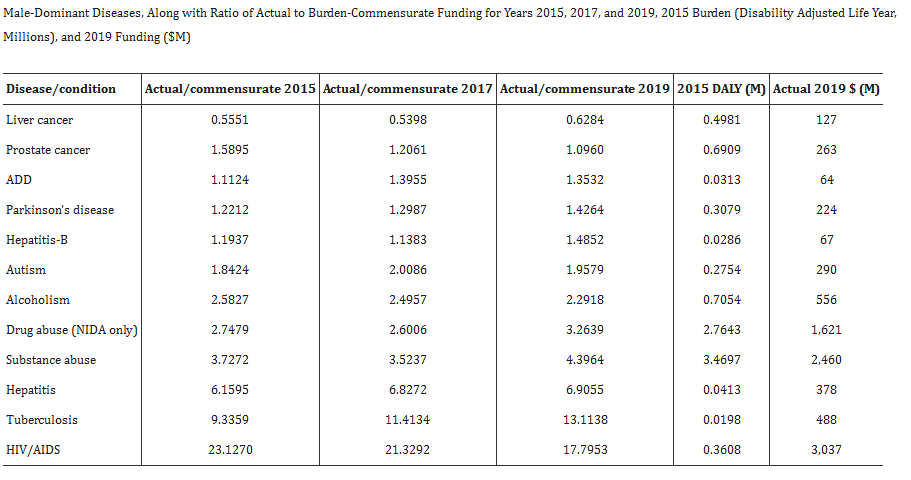
<p>A common argument from feminists is that medical research is skewed towards male-dominated diseases. There’s some research to back this up, although I have qualms with how they use DALYs in their methodology (surely no-one would suggest we fund diseases which impact black people less because they live less long anyway).</p>

<p>Here’s a table from Art Mirin, showing diseases which disproportionately impact men and their level of NIH funding. So based of 2019 funding, HIV/AIDS is over-funded by a factor of 17.8 relative to its benefit (based off a simple regression), and all but one condition is over-funded.</p>

<p><img src="/assets/mirin.png" alt="Art Mirin table" style="display: block; margin-left: auto; margin-right: auto; max-width: 100%; height: auto;" /></p>

<p>An astute reader can probably see where I’m going with this, especially if they’re aware that TB mostly impacts the immunocompromised in the West and that the different varieties of Hepatitis are caused by such things as needle sharing, alcoholism and STDs. The most overfunded gender-neutral condition in that paper is infertility and the most overfunded female-dominated condition is STDs/Herpes. While I think he may not have done a great job with categorizations, similar findings are made by other researchers.</p>

<p>Contrary to narratives that this is the cis-hetero patriarchy in action, it becomes immediately obvious eyeballing the data in this paper and others that we’re over-subsidizing research into diseases which are caused by lifestyle decisions. Men are disproportionately benefitting from medical research because they’re more likely to be degenerates. It’s no coincidence that two of the biggest medical breakthroughs of the 21st century are PrEP and GLP-1 drugs; the telos of the modern West is to protect people from the consequences of their own actions.</p>

<hr />

<p>A small digression. My view is that a civilization reaches its apogee when the negative tendencies (which have been growing stronger) equal that of the positive tendencies. A turning point in the overall trajectory of a society in no way implies that there was a reversal in any of the underlying trends; it might just be that’s the time at which the negative tendencies begin to outweigh the positive ones. To put it in a simple metaphor: a rocket doesn’t begin returning to earth because gravity has started acting on it. Gravity was always acting on it. But at a certain point gravity more than offsets the lift generated by the chemical propellant.</p>

<p>Many developments have both positive and negative effects. So for instance classical writers often claim that an accumulation of material wealth (good) will in turn lead to vanity, class envy, a loss of social cohesion etc. This is true especially of technology, which usually improves over the course of a civilization, augmenting its power, even as it undermines many of the qualities that said civilization rests on (personal virtue, say).</p>

<p>What is unusual about the development of these pharmaceuticals which further enable debauchery is not so much that they might have downsides by perpetuating behaviour that is harmful, but that it seems to be the <em>point</em> of modern “progress”. This is so common that we almost habitually equate progress with further degradation; start-ups in Silicon Valley with pernicious side-effects are overfunded precisely because it makes them seem of the future.</p>

<hr />

<p>The left became supportive of drug abuse and sexual promiscuity in the 60s, ostensibly as a form of liberalism whereby people could choose any lifestyle which did not impinge upon others. This characterization is insufficient; rather I’d argue the modern left abhor people being subjected to standards of any sort, regardless of the harm caused to others or society more broadly. On this basis they oppose the criminal justice system, sexual mores, academic standards, beauty standards, gender norms, psychometric testing, cultural integration of immigrants, etc. Today even standards of competence at work are attacked as “ableism”.</p>

<p>My admittedly speculative psychological explanation is that many people on the left today feel, in their personal lives, that it’s a struggle to meet the standards imposed upon them. In reaction to this they support a politics which seeks to overturn all established standards and conventions in the vain hope it will alleviate their own insecurities.</p>

<p>This explains the well-known paradox that the norm-destroyers are <em>more</em> likely to abide by said norms, because they are more psychologically predisposed to worry about them in the first place. So the pro-crime criminologist is among those least-likely to commit crimes, the most educated strata of society most vociferously oppose standardized testing in schools, democrats are thinner than republicans but also campaign for more acceptance of obesity, and so on. It also explains the trend of young women herding to the left, as they always and everywhere more keenly feel either real or perceived societal expectations.</p>

<p>While previous writers have adumbrated this idea before, I’ve seldom seen discussed why it’s getting worse over time. If the abolition of repressive norms has been the <em>sine qua non</em> of the new left since the 60s, how are people not already somewhat liberated? The answer is simple if counter-intuitive: when you destroy common expectations they’re replaced by imagined ones which might be more onerous than the original ones.</p>

<p>To make this more concrete with an example, consider that school students used to have their bodies measured in various ways as well as their fitness levels. Naturally this practice was halted in the latter part of the 20th century because it was thought that it led to invidious comparisons and psychological harm. But I’m suggesting the reverse: remove the external and quite reasonable standard, then many students will become obese but others will develop eating disorders and become obsessed with their body-weight. Each individual’s standard is no longer anchored to the external standard.</p>

<p>Unrealistic self-standards are not the only reason this is harmful. The <em>internalization</em> of norms which were formerly provided by one’s social setting itself leads people to become more neurotic. There is a parallel here with the classic Žižek parable. An authoritarian parent might force their child to visit the child’s grandmother, while a modern permissive parent might say “you know how much your grandmother loves you! But nevertheless, I do not want to force you to visit her”. In practice this not only requires the child to visit the grandmother, but puts the onus on the child to force themselves to do so.</p>

<p>The lack of social coercion to do what is best is exacerbated by other incentives also becoming more perverse over time. Consider a young person today. On the one hand they can choose various highly convenient short-term dopamine hits: video games, pornography, substance abuse, etc. On the other hand the “good” behaviour has uncertain and distant rewards. If you study hard tonight you might get better grades which might imperceptibly improve your chance of a decent job after graduating. If you hit the dating apps you might have a 0.0x% chance of meeting your future partner after a grueling dating process, although more likely you’ll meet nothing but rejection. If you apply for jobs… you get the idea. We are not evolved to have such an extreme time-preference and so we must find strategies to force ourselves to do these tasks.</p>

<p>One often hears people say when dieting they just fat-shame themselves in front of a mirror to keep their diet on track. Modernity makes people fat through advances in food technology and jobs which force them to be sedentary, and then denies them even the motivation they might have got if their friends had fat-shamed them. The solution, self-shaming, is almost certainly psychologically detrimental but becomes a necessary disciplinary tool.</p>

<p>In addition to exaggerating the shame of failure, another motivational strategy is to magnify the rewards from success. Those who don’t want to fall into the abyss like many of their peers may concoct grandiose visions of their future to motivate themselves. This results in the perpetual self-improver, those who abstain from almost all pleasure in an indefinite loop of self-improvement (gym, study, work) with no end in sight. Often these plans border on delusional (e.g. expecting a slightly better bench-press to magically procure a girlfriend), and these individuals spend their lives preparing for a future which will never arrive.</p>

<hr />

<p>Those who are more neurotically inclined to impose high standards upon themselves, through one method or another, will tend to succeed more in schools and in the workforce, with this advantage becoming more pronounced the more public standards are stripped back. They disproportionately end up in the privileged classes and then use this position to further erode public standards of behaviour, wrongly believing they are the source of their neuroses. We are trapped in this positive feedback loop.</p>

<p>In the long run I predict this means society will continue bifurcating into two groups. Those who capitulate to short-term pleasure seeking in the absence of external constraints, and a much smaller and highly neurotic group of strivers who all end up in therapy and suffer from mental illness and anhedonia. The latter feel unfree due to their obsessive self-monitoring and self-critique, but this is a response to the very anomie which they perpetuate and further intensify in the false belief it will liberate them.</p>

<p>At our current level of technological development we are still dependent on individuals making good decisions. The ongoing crusade to protect individuals from the consequences of their own actions is anti-civilizational insofar as it further encourages poor behaviour. This remains true even if in some isolated instances we accomplish it with few downsides, as in the case of the pharmaceutical solution to obesity.</p>]]></content><author><name></name></author><summary type="html"><![CDATA[The Rise and Rise of the Superego]]></summary></entry><entry><title type="html">The New Complexity Trap</title><link href="https://baazaa.github.io/2026/03/10/complexity.html" rel="alternate" type="text/html" title="The New Complexity Trap" /><published>2026-03-10T01:00:00+00:00</published><updated>2026-03-10T01:00:00+00:00</updated><id>https://baazaa.github.io/2026/03/10/complexity</id><content type="html" xml:base="https://baazaa.github.io/2026/03/10/complexity.html"><![CDATA[<h1 id="the-new-complexity-trap">The New Complexity Trap</h1>

<p><span class="publish-date"> Published on  10 March 2026</span></p>

<p>In my professional life I’ve repeatedly seen the same pattern.</p>

<p>The first example involves a system a bit like the tax system. It’s made up of rules for revenue generation, those rules are supposed to encourage good behaviour, which in turn requires that they be understandable by the general public. The rules also have to be administered by government, which nowadays means being encoded in software implementations.</p>

<p>This system, like modern tax systems, is incredibly convoluted, so that it’s impossible to get the incentives right. No-one could follow those incentives even if they did exist because no-one understands the system anyway and the taxpayers are deeply unhappy because they suspect they’re being rorted by government in the fine print. The cost to administer the system is so high that it eats into a lot of the revenue it’s supposed to generate.</p>

<p>Everyone with any knowledge of this system is appalled with the unnecessary complexity and has implored the government to simplify it. The minister’s office, which has no understanding of the system whatsoever, has repeatedly rejected these pleas.</p>

<p>The second example is the machinery of government. Every few years there’s a government restructure. The portfolio is a byzantine mess riddled with waste, duplication and inefficiency. Even when teams do important work, no-one can find them because there’s no internal logic in the org-chart. Anyone with a working knowledge of this system can easily proffer many simplifications which would restore some level of order.</p>

<p>Unfortunately the decisions are made by people with no working knowledge of the system; typically senior-managers who’ve been parachuted in from the private sector who don’t know what anyone does, who further delegate the work to consultants who are even more clueless. Consequently with every restructure the government becomes even more labyrinthine, which ultimately confounds the senior managers who made the decision as they’re most often the ones who might need to consult an org-chart.</p>

<p>The third example is one many will be familiar with: tech debt. Like many I’ve seen archaic systems where something that should take an hour might take a week. The trouble, as anyone who’s ever been in this situation can attest to, is that non-technical managers invariably fail to understand the problem.</p>

<p>Of course the standard claim at this point is that engineers are just bad at communicating. They simply need to re-express their ideas around refactoring etc. in terms of ‘value to the business’ or some such. But I’ve never seen this work. Instead I’ve seen the same thing over and over: people who understand complex systems also understand the importance of minimising that complexity wherever possible; people who have never understood a complex system in their life never ever grasp this and cannot be convinced.</p>

<p>Imagine you’re a dumb non-technical manager. You think coding is basically magic. Sometimes when you ask the engineers to add a feature (which is like casting a spell), they give some weird story about how they could cast the spell quickly, but it’s better to do so slowly to prevent their magic becoming impotent and making future spells take longer. This is obviously unconvincing; it sounds like something slackers would say. So why are we surprised when managers who think like this fail to grasp the importance of controlling tech debt?</p>

<hr />

<p>Joseph Tainter famously claimed that the rise and fall of civilisations can be explained through the lens of complexity. Simple societies adapt to crises through adaptations which increase complexity. As these societies advance they accumulate more and more complexity, scars from past traumas, which make them too sclerotic to adapt to future challenges.</p>

<p>While I think this narrative is overdrawn, there’s some truth to it. And what we’re doing as a civilisation is speed-running this process. All our systems are growing more complex more rapidly than is necessary, because the people who make the decisions which control how complex they become are idiots who’ve never had to wrangle with complexity and so cannot grasp the advantages of simplicity.</p>

<hr />
<p><br />
Next consider AI. Assuming we see only marginal improvements hereafter (plausible given the trajectory over the last few years) it has two qualities:</p>

<ol>
  <li>
    <p>A tremendous superiority to humans in terms of working-memory and the ability to traverse documentation, which means it can easily work with systems much too complicated for a human to keep in their head.</p>
  </li>
  <li>
    <p>It’s presently inferior to humans in controlling complexity when modifying systems. It fails to see things in a holistic fashion; in some sense it is brute-forcing the problem.</p>
  </li>
</ol>

<p>Even if 2 is solved, there’s no reason to expect AIs not to run into the same problem humans do. Just as human-coded projects tend to reach a level of complexity with which its own authors struggle, so too will AIs, even if that level of complexity is unfathomable to humans.</p>

<hr />
<p><br />
So let’s consider what might happen when you combine AIs with the phenomenon I began with.</p>

<p>Take the legal system, a textbook example of a system that’s grown too complex. We have tried to cope through ever-greater specialisation so that individual legal experts can stay on top of their specific area of the law, but this is not a sustainable solution. The problem is exacerbated because new laws from legislators and regulators tend to be poorly written, verbose, overly vague, sometimes contradicting other laws, etc. This is because the best legal minds aren’t going into politics or working for the government regulators, so we have idiotic managerial-types vandalising the system as described in the opening section.</p>

<p>LLMs are especially well-equipped to handle the situation. They can trawl through regulations or case-law to find relevant precedent. Their linguistic capabilities are sufficient for the task. Their lack of creativity, undoubtedly a demerit in many fields, is almost a positive when it comes to legal reasoning. So even today we should expect the rapid adoption of AI by legislators, regulators, lawyers, judges, etc.</p>

<p>What this means, in practice, is that humans will increasingly not interact with the laws directly, but will interface with them through AI. The law becomes a black-box. Some predictions from this:</p>

<ol>
  <li>
    <p>The marginal cost of idiotic modifications to the system will go down. Consider how many pages of regulation get churned out currently, then imagine how much greater it will be once you no longer need to employ people to do it.</p>
  </li>
  <li>
    <p>The immediate downside to this is obviated because it will be the LLMs who have to contend with these changes.</p>
  </li>
  <li>
    <p>In the long-run the legal code in the black-box will degrade in quality to such an extent that even AI struggles. In part this is because they’re bad at controlling the complexity budget when modifying systems, but mostly it will simply be that the directives they’re receiving are stupid and they’re too obsequious to push back.</p>
  </li>
  <li>
    <p>Naturally the power and market compensation of people who do understand complex systems will be destroyed by competition with the AIs. We might have a generation or two that doesn’t invest any time or effort into understanding complex systems because there’s no reward, only for us to collectively find out that all the systems are broken.</p>
  </li>
</ol>

<p>To reiterate, the problem here is not really the AI. The problem is we have a lot of very dumb managers who think they can control systems they don’t understand. This it not possible. They will not be able to articulate what they want from these systems, they will not be able to understand the outputs of these systems, they will regularly ask for things which are impossible, and we know this because we see it <em>today</em> when managers interact with high-skilled professionals. Replacing the high-skilled professionals with AI won’t address the major problem, it will make it worse.</p>

<p>Put another way: we should be worrying not just about AI-alignment, but the alignment of the complex systems AI interacts with. If the tax code is already misaligned, why we would expect AI to fix it just because it can speak English, is reasonably benevolent and intelligent? The people who currently work with the tax code also speak English, are reasonably benevolent and intelligent, and yet the tax code is horribly misaligned (according to everyone: tax officials, economists, politicians, voters, lobbyists, accounting bodies, etc.)</p>

<p>And while this post has so far mentioned systems already over-burdened with complexity, there are others that still work fairly well. The electricity grid, air traffic control, banking, code compilers, etc. We need to consider what happens if by 2060 no-one understands these systems at all but they still need to be modified. My suspicion is that if people who don’t understand these systems try to control them it will go about as successfully as say Number 10 controlling the British government currently.</p>

<p>Unless AI gets considerably <em>smarter</em> than humans it could end up being a net-negative. AI is going to do for intellectual labour what slaves did for manual labour. Slaves mostly did work that would otherwise have been done by freemen, while devaluing the status of work and creating an idle culture. AI is going to devalue intellectual work while, like slavery, having negative second-order implications for the political economy. So we better hope they’re superior substitutes or complements for high-skill professionals, not mere equals.</p>]]></content><author><name></name></author><summary type="html"><![CDATA[The New Complexity Trap]]></summary></entry><entry><title type="html">WW3</title><link href="https://baazaa.github.io/2026/03/10/ww3.html" rel="alternate" type="text/html" title="WW3" /><published>2026-03-10T00:00:00+00:00</published><updated>2026-03-10T00:00:00+00:00</updated><id>https://baazaa.github.io/2026/03/10/ww3</id><content type="html" xml:base="https://baazaa.github.io/2026/03/10/ww3.html"><![CDATA[<ul id="markdown-toc">
  <li><a href="#democracy-and-world-wars" id="markdown-toc-democracy-and-world-wars">Democracy and World Wars</a>    <ul>
      <li><a href="#timeline" id="markdown-toc-timeline">Timeline</a></li>
      <li><a href="#diplomacy" id="markdown-toc-diplomacy">Diplomacy</a>        <ul>
          <li><a href="#timing" id="markdown-toc-timing">Timing</a></li>
          <li><a href="#remilitarisation-of-the-rhineland" id="markdown-toc-remilitarisation-of-the-rhineland">Remilitarisation of the Rhineland</a></li>
          <li><a href="#spanish-civil-war" id="markdown-toc-spanish-civil-war">Spanish Civil War</a></li>
          <li><a href="#munich" id="markdown-toc-munich">Munich</a></li>
          <li><a href="#prague-and-the-polish-guarantee" id="markdown-toc-prague-and-the-polish-guarantee">Prague and the Polish Guarantee</a></li>
          <li><a href="#soviet-negotiations" id="markdown-toc-soviet-negotiations">Soviet Negotiations</a></li>
          <li><a href="#final-days" id="markdown-toc-final-days">Final Days</a></li>
        </ul>
      </li>
      <li><a href="#war" id="markdown-toc-war">War</a>        <ul>
          <li><a href="#strategy" id="markdown-toc-strategy">Strategy</a></li>
          <li><a href="#saar-offensive" id="markdown-toc-saar-offensive">Saar Offensive</a></li>
          <li><a href="#ruhr-bombing" id="markdown-toc-ruhr-bombing">Ruhr Bombing</a></li>
          <li><a href="#the-nordic-misadventure" id="markdown-toc-the-nordic-misadventure">The Nordic misadventure</a></li>
          <li><a href="#fall-of-chamberlain" id="markdown-toc-fall-of-chamberlain">Fall of Chamberlain</a></li>
          <li><a href="#fall-of-france" id="markdown-toc-fall-of-france">Fall of France</a></li>
        </ul>
      </li>
      <li><a href="#post-mortem" id="markdown-toc-post-mortem">Post-mortem</a></li>
    </ul>
  </li>
</ul>

<h1 id="democracy-and-world-wars">Democracy and World Wars</h1>

<p><span class="publish-date"> Published on  10 March 2026</span></p>

<p>One of my biggest concerns that few share is that I think it’s quite likely Western democracies will blunder into a world war. The reason more people don’t take this seriously is they’re unaware of how badly democracies have performed in the past. So I thought I’d give a case-study, namely the lead-up to WW2 in Europe. My angle is realist and if I spend little time assigning ‘blame’ it’s because I view it as irrelevant.</p>

<p>My original intent was to cover the US as well but this became far too long anyway. As I have a day-job most of this is derived from secondary sources, although for reasons I elaborate at the end I believe historians have done a poor job synthesising their research (or making it known to the general public).</p>

<h2 id="timeline">Timeline</h2>

<ul>
  <li>March 1936: Remilitarisation of the Rhineland</li>
  <li>July 1936: Start of Spanish Civil war</li>
  <li>March 1938: Anschluss</li>
  <li>October 1938: Occupation of Sudetenland post-Munich</li>
  <li>15 March 1939: Hitler takes rest of Czechoslovakia</li>
  <li>31 March 1939: British guarantee of Poland</li>
  <li>23 August 1939: Molotov-Ribbentrop pact</li>
  <li>25 August 1939: Anglo-Polish mutual assistance agreement</li>
  <li>1 September 1939: Invasion of Poland</li>
  <li>3 September 1939: France and GB declare war on Germany</li>
  <li>17 September 1939: Soviet invasion of Poland</li>
</ul>

<h2 id="diplomacy">Diplomacy</h2>

<h3 id="timing">Timing</h3>

<p>Before going through the chronology of possible intervention points, we must first consider with the benefit of hindsight what the best timeline was.</p>

<p>Germany started off partially disarmed due to Versailles, and then engaged in a program of rapid rearmament after 1933. This rearmament was speed-limited by natural resource / foreign currency constraints, and as Germany had a weaker economic base meant that France and GB could more-or-less keep up once they responded (even though each was spending a much lower % of GDP). The net-result is that the optimal time for the war from Germany’s perspective was probably sometime around 1937-1940, taking into account only the arms build-up. However Germany also benefitted from the remilitarisation of the Rhineland and the occupation of the Sudetenland which greatly improving its defensive position, while the later annexation of Prague delivered vital war materiel and Škoda’s factories. This enhanced German diplomatic influence allowing it to secure access to Romanian oil and Soviet raw resources.</p>

<p>With this in mind, let’s go through some events in detail.</p>

<h3 id="remilitarisation-of-the-rhineland">Remilitarisation of the Rhineland</h3>

<p>If ever there was a good time to intervene early, it was when Hitler remilitarised the Rhineland. It was this move which ended at a stroke the Locarno system which had integrated Germany into the world system and normalised relations between it and its neighbours. This move was a bold gamble; Hitler was bluffing and had no forces to fight even a limited engagement, he had instructed the troops to retreat if they met any resistance.</p>

<p>On the British side, not only was there no appetite for a war, many positively supported Hitler’s decision, feeling that the Germans had been treated unfairly by Versailles. In France the public opposed the move in principle, but mostly felt the response should be economic sanctions moved through the League of Nations.</p>

<p>France did <em>consider</em> unilaterally policing Germany with an invasion, despite the lack of public support, but there were obstacles. Gamelin, chief of the Army Staff, pointed out that it could be done but that it would be expensive as it would require a full mobilisation. France was already financially teetering, and the threat of a war combined with the precarious budget situation caused fears over capital flight, inflation and rising taxes. This made the prospect extremely daunting, especially in an election year.</p>

<p>In reality it would not have required a full mobilisation, but the intelligence services had largely been repurposed to provide internal propaganda to justify further budget appropriations for the military. On the one hand the French military really did need more budget to keep up with German rearmament, but the result was that the intelligence greatly inflated the strength of Germany which repeatedly hampered decision-making.</p>

<p>Another issue was the state of the cordon sanitaire. Because the democracies had put so much faith into multilateralism and the League of Nations in the interwar period, the bilateral alliances which provided a fallback were also insufficient. France could not rely on Poland, because their alliance did not require it, and Poland were at the time aligning themselves with Hitler<sup id="fnref:1" role="doc-noteref"><a href="#fn:1" class="footnote" rel="footnote">1</a></sup> with whom they had signed a non-aggression pact.</p>

<p>It’s hard to blame politicians alone for emphasis given to the League of Nations at this time. Voters overwhelmingly believed the key to avoiding another European war was the sort of consensus-based decision-making it represented, which they hoped would allow for a policy of disarmament and increased social spending using the freed-up budget. Predictably this meant that the League of Nations had no teeth, as too many nations needed to be consulted and powers like France and Great Britain lacked the requisite hard-power to bring rogue nations into line. Voters then blamed politicians for the failure brought about by their own paradoxical demands.</p>

<p>Perhaps the best demonstration of this was when Italy invaded Abyssinia. If the League didn’t want war, then the best it could do were economic sanctions with bite, but Italy considered an oil embargo itself to be an act of war. No solution here would have satisfied voters. One reason I bring this episode up is that it contains just about the only instance in the 1930s where the allies attempted realpolitik; the infamous Hoare-Laval Pact giving Mussolini most of Abyssinia so that he might remain in the anti-Hitler Stresa Front. The pact was leaked to the press, causing immense reputational damage to both governments<sup id="fnref:2" role="doc-noteref"><a href="#fn:2" class="footnote" rel="footnote">2</a></sup>, and may partly explain why the British ceased pursuing a sane foreign policy thereafter.</p>

<h3 id="spanish-civil-war">Spanish Civil War</h3>

<p>After the outbreak of the Spanish civil war, all sides signed up to a non-intervention pact, which Italy, Germany and the Soviet Union proceeded to violate quite openly.</p>

<p>Blum, the French premier, was willing to send arms to the Republicans, despite the potential to stoke internecine conflict within the third republic (the catholic right backed the nationalists and the centrists in the popular front were chary about sending arms that might ultimately equip communists). In any case, he was strongly dissuaded by Britain, who feared that such involvement would lead to a series of escalations and ultimately war with the fascist powers.</p>

<p>The political situation in Great Britain at this time needs some elaboration. In the early 30s the electorate was very pacifist (as evidenced by the 1933 Fulham by-election). Ramsay McDonald had taken with him some of the more pragmatic Labour statesmen with him into the national coalition, so that the Labour opposition ended up led by a Christian pacifist, George Lansbury, until late 1935. Stanley Baldwin, head of the conservatives and PM, cynically recognised that he was hardly going to be flanked on the right by a party which advocated for unilateral disarmament in the face of fascist aggression, so he took a ‘peace platform’ to the 1935 election easily capturing the median voter. There were no more elections until 1945. The appeasers could always, with truth on their side, claim that there was no electoral mandate for a hawkish line re: Germany.</p>

<p>There was at the same time a great hysteria about the threat posed by airpower. Many planners believed that, despite the strategic weakness of Germany, it might be able to bomb London into submission at the very outset of a war. These unfounded fears were motivated by competing factions each with their own concerns: the disarmament movement sought to rationalise their stance, figures like Churchill tried to come up with continental threats to break Britain out of its isolationism, and politicians like Baldwin and later Chamberlain realised these fears complemented the appeasement line they wished to take due to electoral calculations.</p>

<p>As the 30s progressed, better-informed MPs and journalists started to criticise the government for its ultra-dovish line. These attacks were perceived as politically opportunistic, and the net-effect of the sniping from the likes of Churchill was to negatively polarise the government into hardening its stance. Instead of moving to a substantively more hawkish outlook, the government instead spent ever more energy <em>pretending</em> to take the threat from Hitler seriously, so as to blunt the accusations of inaction. This resulted in a rapid proliferation of committees with no commensurate improvement in preparedness.</p>

<p>To give a specific example, Baldwin decided to appoint a minister for coordination of defence, in response to widespread criticism that the rearmament lacked direction. Baldwin appointed to this post Thomas Inskip, a barrister hopelessly out of his depth, in ‘the most cynical appointment since Caligula made his horse consul’. The appointment was made with domestic political calculations front-of-mind, namely to deny a potential hawk a pulpit from which to criticise the government further, while still pretending to take war preparation seriously. The Potemkin political machinery for war-preparedness would later frustrate genuine attempts to prepare for war.</p>

<h3 id="munich">Munich</h3>

<p>The next plausible trigger-point was over Czechoslovakia.</p>

<p>The French were genuinely torn. They were the ones who had a treaty obligation to the Czechs, not Great Britain<sup id="fnref:3" role="doc-noteref"><a href="#fn:3" class="footnote" rel="footnote">3</a></sup>. But their ability to provide support had relied on the demilitarised Rhineland allowing for a Western offensive, something they’d been well-aware of at the time. Great Britain was stridently opposed to any war over the Sudetenland, and Poland was greedily eyeing Czech territory.</p>

<p>The French understood the dreadful cost of ceding the Sudetenland, an obvious prelude to dismantling the whole nation. From there Germany would dominate central and eastern Europe. After this there would be no way to provide assistance to Poland if Germany attacked, and if Germany thus managed to secure both its southern and eastern fronts France itself would be in peril, especially if the Italians aligned themselves with the Germans.</p>

<p>The principal problem in France was political paralysis. During the Rhineland crisis it had been under the caretaker government of Sarraut, replaced by Blum who led the socialist-dominated Popular Front to electoral victory June 1936. He governed for a year and introduced much left-wing legislation before being replaced by Chautemps of the radicals (the centrists within the populist front), who was eventually replaced briefly by Blum again before Daladier (another radical) becomes PM in April 1938.</p>

<p>The lower house (the Chamber of Deputies) was in a state of chaos due to the breakdown of the left, while the senate was naturally conservative. The radicals did not have a stable majority, rather they were the natural party of compromise between a growing far-left and far-right. Daladier’s hold over his own party was also extremely precarious, forcing him to appoint competitors to cabinet, with Reynaud pushing for a more aggressive foreign policy, and Bonnet pushing for conciliation with Germany. The only reason France wasn’t entirely ungovernable was that occasionally Daladier received delegation from parliament to rule-by-decree, a work-around to deal with the fact that parliamentary politics was unworkable.</p>

<p>Daladier’s own inclination was to stand by France’s treaty commitments to the Czechs; his calculation was that it was better to fight with them in 1938 than without them in 1939. He knew that Britain would likely be compelled to join a French-German war if it occurred, despite the vehement denials from the British that this was the case. Unfortunately he lacked support from the electorate, an overly-pessimistic military establishment, any potential allies (besides the Soviets), and much of his own cabinet. In the event, he did everything short of war to try to get the best deal possible for the Czechs, including mobilising after the humiliating terms dictated by Hitler at Bad Godesberg. This was probably the only way he could keep his job, by taking the most hard-line position short of war and allowing himself to be presented a fait-accompli by Chamberlain.</p>

<p>Perhaps the decisive factor in this was Bonnet, who headed the peace faction as foreign minister. His stance was that it was too late to try to contain Hitler, and that the most prudent course of action was to encourage him to attack in the East rather than the West. For this reason he’s lumped in as an appeaser, although unlike Chamberlain his policy was grounded in good-sense. During the despond post-Munich, his policy was momentarily ascendent with most of the military chiefs conceding that France lacked the strength for containment, which led to the December 1938 French-German Declaration.</p>

<p>Unlike the French, the British seemed blissfully unaware of the strategic issues at stake. This isn’t to say that Chamberlain entirely trusted Hitler<sup id="fnref:4" role="doc-noteref"><a href="#fn:4" class="footnote" rel="footnote">4</a></sup>, he just didn’t assign much importance to the loss of the Czechs as a potential ally. While I’ll explain his own idiosyncratic views later, there were also institutional reasons for this. The post-war retrenchments fell on the Army the hardest, and Britain maintained a policy of avoiding any continental commitment until 1939 (a policy Labour supported even more strongly than Chamberlain). Consequently Britain didn’t have much interest in the balance of land-forces on the continent, it was a problem for the French to worry about.</p>

<p>Chamberlain claimed that appeasement was part of a dual policy, giving diplomacy a chance while also gaining time for rearming. This was mostly to nullify potential future criticism; in truth British rearmament was sluggish, with Chamberlain seizing on the most hawkish lines from Treasury to argue against a more rapid build-up. In any case the focus of this rearmament was air-defence including the Chain Home, an early-warning system utilising the recently-invented radar. If the war had gone as intended, the principal result of this would have been to redirect German bombers to hit unprotected French cities instead. How was this to compensate the French for the loss of one million men in a modernised army sitting in well-built mountain-forts jutting into the belly of Germany?</p>

<p>I’ll skip the play-by-play of what happened in the negotiations, suffice it to say that it’s a matter of interpretation as to who ultimately won. Judged as an ordinary instance of great-power politics, it was a humiliating capitulation by the western democracies. On the other-hand, Hitler really was eager for war, and Chamberlain for peace at any cost, so on that basis Chamberlain accomplished his aims and Hitler was outplayed. Hitler himself was quite angry after the conference, and would later claim that an earlier outbreak of WW2 would have been more to his advantage.</p>

<h3 id="prague-and-the-polish-guarantee">Prague and the Polish Guarantee</h3>

<p>Less than half a year later, Germany annexed the rest of the Czech state, divvying up some of the spoils with Hungary and Poland and leaving a Slovak rump-state. Chamberlain’s statement to parliament on the 15th of March in response was curiously apathetic, much to the consternation of the government’s supporters. His immediate instinct, expressed in cabinet as well, was to make a legalistic argument that Britain had not formally reneged on any obligations from Munich as the Czechs hadn’t tried to resist the invasion. Naturally this outraged many of his colleagues.</p>

<p>An MP (an anti-appeasement conservative) wrote in this diary on the 17th: “The feeling in the lobbies is that Chamberlain will have either to go or completely reverse his policy. Unless in his speech tonight (in Birmingham) he admits he was wrong, they feel that resignation is the only alternative…”As it would happen, Chamberlain did take a much tougher-line in that speech, which anticipated a sudden reversal of government policy…</p>

<p>Before presenting my own view, it’s worth explaining the historiographical situation to the lay-reader. There is an immense amount of documentation about what happened in March 1939, and this topic has been the subject of a great deal of research. And yet historians do not agree on the basic facts. The problem, I’m convinced, is that historians seek the <em>rational strategic basis</em> for the unilateral guarantee of Poland given on the 31st of March, but there was none, and there’s a superabundance of evidence that confirms this and refutes all of the laboured attempts by historians to provide one.</p>

<p>To return to the narrative, Chamberlain faced a near revolt from the backbench and there was a sea-change in public opinion. This was mirrored overseas with Chamberlain coming under diplomatic pressure. Joseph Kennedy, the ambassador, said that the American public doubted whether the British government ‘really meant business’ (the opinion of the isolationist US shouldn’t have had so much weight, but both Chamberlain and Halifax the foreign minister cared a great deal about the UK’s moral standing on the world stage.) This added to growing concern from over the channel, as French opponents to Bonnet’s appeasement warned that if Britain didn’t make a decisive commitment to containing Germany then Bonnet’s faction would win out.</p>

<p>So there were innumerable reasons for why the government decided it must do something (not least of which was the personal betrayal felt by Chamberlain), however the form this would take was unclear. Early proposals mooted a large international conference to set up an anti-German eastern alliance, which invariably would have involved concessions from Poland in return for any guarantees from the Western allies (e.g. to ally with Romania which was beginning to cave to German’s importunate demands for their oil). The Poles, sensing this, counter-offered by suggesting a bilateral agreement with Britain.</p>

<p>As this was occurring, a Romanian diplomat falsely claimed that Germany was planning an imminent invasion of Romania in the 17th. Germany demanded and received Memel from Lithuania on the 23rd of March. Rumours circulated about movement against Romania or Poland, which culminated in a News Chronicle correspondent giving an account directly to Chamberlain and Halifax on the 29th that Germany was imminently about to invade Poland. Ordinarily the wild story provided would have provoked more scepticism, but in the febrile atmosphere which prevailed it was enough to push Chamberlain and Halifax over the edge.</p>

<p>On the 31st Chamberlain gave a statement to Parliament, unilaterally guaranteeing the independence of Poland. The precise wording suggested that it was up to Poland to decide what constituted such a threat. Chamberlain himself didn’t realise this, believing he had <em>not</em> guaranteed Poland’s territorial integrity but merely its independence, although the final draft reflected more Halifax’s bolder views. The press, helpfully trying to make the guarantee more sensible, suggested that Chamberlain had not committed Britain to the defence of Danzig, which angered the Poles who demanded a foreign office clarification which, published in a communique on the 3rd of April, confirmed that Poland was in the driver’s seat.</p>

<p>The guarantee was intended to be a stop-gap until the Eastern bloc could be established on more solid grounds. But the binding agent for this bloc would have been the promise of a commitment from Britain. Having given that up for free before any negotiations started, Halifax now found that he had little leverage. The Poles returned to their obstinate uncooperativeness which had long-characterised Franco-Polish relations (Daladier was furious upon finding out about the guarantee, Bonnet had signed off on it without consulting him. Gamelin rued that the guarantee had not been made conditional on allowing the Soviets to pass through Polish territory to help fight in the event of war.)</p>

<p>The British had lost leverage with everyone else as well. Stalin had naturally feared that Germany would go through Warsaw to get to Moscow, but now he was in position to choose if or when to ally with either side. The French, while upset that Chamberlain had made such a blunder, were nonetheless now in a much stronger position to make demands on the UK, which resulted in the introduction of conscription in April and the promise of a substantial British Expeditionary Force.</p>

<p>The biggest issue with the guarantee was that although Chamberlain had hoped to ‘buy time’ with it while Britain rearmed, it was not a credible threat of deterrence. Poland could only hold out for a few months at most without Soviet assistance, as was recognised by the German, French and British generals (but not by the Poles themselves). The Chiefs of Staff had recommended against issuing the guarantee for this reason, but Halifax not only ignored their advice, but misrepresented the military value the Poles could provide to cabinet.</p>

<p>Because guaranteeing Hitler’s next target without any feasible hope of defending it makes so little sense as a means of ‘buying time’, a whole school of thought sprung up that actually Chamberlain was cynically baiting Germany into a war earlier than Hitler intended. This is hard to square with his private correspondence, but the fact that many historians have seriously entertained the possibility shows that Chamberlain’s strategy was, in the very literal sense, <em>incredibly</em> stupid.</p>

<h3 id="soviet-negotiations">Soviet Negotiations</h3>

<p>Once the Polish guarantee had been given, it was agreed widely agreed, across faction lines, in both governments, that it was an urgent priority to negotiate an alliance with the Soviet Union. While many held doubts about the effectiveness of the Red Army, their allegiance would guarantee a deep second-front while denying Germany access to their natural resources. Even many anti-communists who opposed the polish guarantee and had hoped Hitler would strike eastwards recognised that, the guarantee having been given, it was necessary to make a deal with Stalin.</p>

<p>More sceptical was Chamberlain, Halifax and elements of the foreign office. They had a deep ideological distaste working with communists, they were concerned about Russian designs on the Baltics, and perhaps most importantly they didn’t understand the strategic value in the relationship. They were mostly focused on the extent to which Russia might help defend Poland at the very outset of the war, which was difficult because they no longer had any bargaining chips to induce Poland to allow Soviet troops to reach that border.</p>

<p>The opening of Soviet archives has since shown that the failure of the negotiations was almost entirely due to the British. Molotov’s lack of diplomatic etiquette didn’t help, and he was certainly willing to make full-use of the bargaining power afforded to him by the Polish guarantee, but the Soviets still really did want an alliance with the West. Stalin was still somewhat concerned that Hitler might attack the USSR through the Baltics, coordinating with Japan. Only at the end of negotiations did they start entertaining German counter-proposals. The French had always been alert to the possibility of a Russian-German deal, and reports of it reached the British, but they assumed Stalin had planted the rumours of German cooperation to improve his negotiating position.</p>

<p>The British dragged their feet at every opportunity in the negotiations, were slow to respond to proposals, and tried to add clauses that would make the agreement unworkable (Chamberlain wanted to make action contingent on League of Nations approval). The Soviets signalled that they’d like to speak with someone senior to know that the British meant business, but Chamberlain refused this repeatedly despite the pleading of MPs and colleagues that someone of ministerial rank be sent. The final straw was when the British belatedly agreed to send a military delegation. They sent the delegation the slowest way possible, using a merchantman (overriding strong objections by the French), with no plenipotentiary powers and with instructions to negotiate slowly. Stalin and Molotov drew the correct inference, and sided with Germany.</p>

<p>Nor were they the only ones who suspected that Chamberlain was doing his utmost to at least delay, if not sabotage negotiations<sup id="fnref:5" role="doc-noteref"><a href="#fn:5" class="footnote" rel="footnote">5</a></sup>. The reason he was so often discomfited in parliament by questions about the negotiations is because many MPs believed he was running his own foreign policy. These fears were reinforced when talks leaked between a high-ranking German trade official and Chamberlain’s aide, demonstrating that he’d reverted to his old appeasement ways (and further signalling weakness to Hitler that undercut his own deterrence stance). This was not an isolated instance, Chamberlain pursued a variety of back-channels that we know about, and almost certainly a lot we don’t know about, circumventing the foreign office and even Halifax.<sup id="fnref:6" role="doc-noteref"><a href="#fn:6" class="footnote" rel="footnote">6</a></sup></p>

<p>To give an indication of the level of mistrust, the deputy opposition leader moved to limit the August recess, saying: “I want to put it quite bluntly. A considerable number of Members of this House, not confined to my colleagues on these benches, do not trust this Government. That is the root of the matter to-day. Because of that feeling of distrust we have thought it right to ask for an earlier meeting of this House than the Government propose.”Or to give another MP’s take: ‘The Prime Minister’s attitude this afternoon has confirmed the worst fears of all those who think that directly Parliament is up there will be a tremendous move in the direction of appeasement, and that he will use all his powers to bring about a situation that will place us in the gravest danger and alter the foreign policy upon which we are united at the present time. Some of us hold grave suspicions with regard to what he is doing about Russia… <strong>We know that he does not want an Anglo-Soviet pact, that he will only consent to it if it is forced upon him against his will. His personal antagonism to Russia is well known throughout the country.</strong>”Judging by the number of abstentions by the rebel conservatives (and other evidence), these sentiments were shared by many of Chamberlain’s own party.</p>

<h3 id="final-days">Final Days</h3>

<p>Hitler after Prague was confident that he could take Poland without Western intervention, even more so with the successful conclusion of the Molotov-Ribbentrop pact His views are reasonably well-expressed in <a href="https://ghdi.ghi-dc.org/sub_document.cfm?document_id=1546">this version</a> of the Obersalzberg speech, which I would recommend to the reader. Of note is the claim that post-Munich he decided to attack in the East instead of the West next, which accords with various other decisions he made (like approving plan Z in January, an ambitious naval rearmament program that only made sense if war with Britain was many years away).</p>

<p>The day before the invasion, on the 25th of August, the Polish-British Common Defence Pact was announced, which convinced Hitler there was a serious risk of intervention. He delayed the invasion by five days in the hopes that Ribbentrop might be able to negotiate a Western backdown to no avail. There was at this point no deal possible<sup id="fnref:7" role="doc-noteref"><a href="#fn:7" class="footnote" rel="footnote">7</a></sup>, dexterous diplomacy might possibly have delivered a Munich 2.0 with Hitler taking Danzig and the Polish corridor, but he was concerned that this would leave a vengeful Poland which would simply attack when German armies were occupied elsewhere, ergo he needed the liquidation of the state. That was never going to be politically palatable to the allies after the guarantees they’d made in March and afterwards.</p>

<p>Given Hitler didn’t want war with France and Britain in September 1939, and they didn’t want war with him, a miscalculation certainly occurred. Principally the problem was that Hitler assumed the allies were strategically rational, in which case the Polish guarantee could only be a bluff<sup id="fnref:8" role="doc-noteref"><a href="#fn:8" class="footnote" rel="footnote">8</a></sup>. This had precedent: Bismarck had once correctly called the bluff of Palmerston over Denmark. Hitler failed to recognise that the politicians were just responding to the change in public opinion which had occurred in March. Hitler also believed that even if war was declared, he’d be able to come to terms with the Western powers after the invasion was successfully completed, as a broader war would make no sense. This failed to recognise that the war itself would further polarise western voters against him, making such a deal untenable for an elected leader.</p>

<p>Chamberlain was somewhat surprised by the news of the invasion on September the 1st (many were quietly hoping that Hitler had been bluffing). He gave a statement to parliament which, repeating his post-Prague performance, was so insipid it disgusted many MPs who thought he was trying to avoid war. Chamberlain would later claim he was forced into this because he was trying to synchronise the declaration of war with France, which has some truth to it, but the event shows how little trust he commanded among parliamentarians.<sup id="fnref:9" role="doc-noteref"><a href="#fn:9" class="footnote" rel="footnote">9</a></sup></p>

<h2 id="war">War</h2>

<h3 id="strategy">Strategy</h3>

<p>Before going through events in detail, a quick description of the general war strategy must be provided. The standard account is that French and British planners envisioned a ‘guerre de longue durée’. In the first phase, the allies would be on the defensive while maintaining an economic blockade of Germany (which would be organised by the British), and then in the following phase, after having accumulated a sizable lead in armaments, the allies would take the offensive.</p>

<p>Historians are being charitable when they describe this as a considered strategy. For one thing, the French would have preferred a guerre brève back in 1936 if they’d had British and Polish support. For another, French planners had always assumed that Germany would be fighting a two-front war, which would prevent the Germans from concentrating too many forces on the Western front and keep them from accessing the resources of Eurasia. The Molotov-Ribbentrop pact had blown French strategic calculations to smithereens; their subsequent rapid disillusionment with this strategy must be viewed in this context.</p>

<p>Chamberlain’s own views are sufficiently idiosyncratic and important that they can be considered separately. He drew on the ideas of Liddell Hart, who over-extrapolated from WW1, and then combined this with an incredibly selective reading of the intelligence coming out of Germany re: the economy and public opinion. I would go so far as to say his views were delusionally optimistic:</p>

<ul>
  <li>Offensive operations in the West were impossible and that the British should participate in the war principally through the RAF (he belatedly abandoned this strategy in 1939 due to French pressure)</li>
  <li>Hitler understood this, and wouldn’t even attempt a Western offensive. If he was mad enough to try, he would be dissuaded by his generals or fall in a coup.</li>
  <li>The German people, once they realised the war was unwinnable and suffering under rationing, would spontaneously rise and overthrow the Nazi regime. Then the war would fizzle out without the Nazis in charge, so that the war would likely last less than a year and there would be no large-scale combat.<sup id="fnref:10" role="doc-noteref"><a href="#fn:10" class="footnote" rel="footnote">10</a></sup></li>
</ul>

<p>The misguided nature of British policy makes much more sense once realises the PM who dominated his government held these beliefs. For instance, his relative indifference to the loss of the Czechs and Russians, his obsessive focus on air-defence, the dilatory nature of rearmament and war planning, and his priority of avoiding escalation during the Phoney war (he still intended to come to peace with the Germans, just not with Hitler).</p>

<p>It’s remarkable how confident he was in both his understanding of the war, and his ability to predict Hitler’s decision-making despite abundant evidence that he could not. Hitler had chosen September to launch the invasion as it was fairly late in the campaigning season, anticipating the possibility of a potential western counter-offensive. As such, a lull after the invasion of Poland was always expected (besides the need to reorganise, repair tanks etc.), and bad weather further delayed German plans. This was universally understood by military men, who repeatedly warned Chamberlain that they were in the calm before the storm. Chamberlain, who rejected much of their advice through the war, was sceptical and every day where nothing happened further entrenched his view that the war was all but over and that he alone understood the situation. He was sufficiently certain of this that he expressed his views in public, saying on the 4th of April that Hitler had ‘missed the bus’ in words that would soon haunt him in parliament. Five days later Germany invaded Norway and Denmark.</p>

<p>Naturally the war planners in his government couldn’t assume the war would just go away like the PM did, but they did have to rationalise the resulting policy to some extent. This is a very important point: policy creates its own justification in a democracy. If the understanding of the war among the allies became incoherent during the phoney war, it was because planners had to reconcile insane policy pushed by politicians with available evidence.</p>

<p>The most obvious example of this was a tremendous faith in blockading, that was only very partially shared by The Ministry of Economic Warfare. MEW did an admirable job of enforcing the blockade in difficult circumstances, but they had to temper expectations<sup id="fnref:11" role="doc-noteref"><a href="#fn:11" class="footnote" rel="footnote">11</a></sup>. The blockade was certainly <em>not</em> going to deliver a knock-out blow, rather it would gradually deliver a small but significant advantage to allied war efforts over German ones. This was a difficult pill to swallow because no-one had any plans for what offensive operations would occur in later phases of the war, and yet even the ‘pessimistic’ planners assumed the war would only take 3 years despite the absence of a credible approach to doing so.<sup id="fnref:12" role="doc-noteref"><a href="#fn:12" class="footnote" rel="footnote">12</a></sup></p>

<h3 id="saar-offensive">Saar Offensive</h3>

<p>At the outset of the war while Germany was occupied in Poland, France had a force ratio of around 5:1 on the Western front versus Germany, although with a more considerable advantage in armour and artillery. By all accounts, a major offensive on the Saar front would have caused the German line to collapse within a week or two. This would not have won the war, as the Polish invasion went so successfully that the French only had a few weeks to act before redeployments from the East (most especially the Luftwaffe) would neutralise their tremendous advantage. But it would have been enough time to occupy the industrially-important Saar region, seize the contents of warehouses, disrupt the coal mines, strip the Siegfried line, and so forth.</p>

<p>While many have criticised Gamelin for being overly-defensive and missing this opportunity, I think this is slightly missing the point. He had 10 divisions sally forth from the Maginot line and then meander about in minefields for a month between the two defensive lines under ever-present threat of German air-attack. ‘Defensive’ is not the word that first comes to mind.</p>

<p>The offensive was for show, but for whom? The Poles were being wiped off the map. It’s hard to see how neutral observers like the Americans would be impressed by the limp-wristed faux-offensive. The soldiers involved in the farce became dispirited. The intended audience was the French journalist and voter, who read confected communiques from the front about great battles being waged in an effort to assist the Poles. The Germans were astonished at the outright falsehood of these press reports, which General Wagner called ‘unworthy of a great nation’.</p>

<p>The purpose of the publicity stunt isn’t hard to fathom, the guarantee of Poland meant they had to pretend to try to pre-empt political pressure that they weren’t doing anything. Gamelin did not need persuading, he had only survived so long in his position despite the political turmoil in the civilian government by being well-attuned to the political sensitivities back in Paris. He possessed the virtues of a civil servant rather than a general. His role especially required delicacy because civilian-military relations in the Third Republic were always uneasy (they had no recovered since the Dreyfus Affair), so he was forever playing a carefully balancing-act between his own subordinates and the politicians.</p>

<p>While the fake offensive was for political reasons, why not a real one? Partly this was because Daladier calculated that a bloody offensive would be politically disastrous and lead to accusations that they had learnt nothing since WW1. But it also aligned with interwar planning, the French had long dreaded another slugging-match with Germany on their territory so their aim was a guerre ailleurs, a war elsewhere. This meant no combat on the Saar front, an advanced defensive front in the low countries, but ideally combat would be relegated to other theatres where the body-toll could be more equally shared between Britain, France and the colonies. Insofar as France was trying to minimise the fraction of casualties which were theirs, rather than win the war, there was some logic in avoiding a major offensive at this juncture.</p>

<h3 id="ruhr-bombing">Ruhr Bombing</h3>

<p>If the allies weren’t willing to shed any blood to damage the German economy, they could perhaps have bombed the Ruhr while the Luftwaffe was occupied in Poland, a suggestion repeatedly made by Bomber Command. It’s debatable how effective this would have been; despite the British thinking that future wars would be decided by strategic bombing, and despite having five years to prepare, they entered the war with a small number of medium bombers without the equipment and training to make much effective use of them. The Germans who had no doctrinal interest in bombing cities had perhaps better capacity to do so, so German retaliation might have been worse than the damage that the British could do.</p>

<p>Regardless of the strategic calculus, Chamberlain would have vetoed any attempt to use them on the basis it would make Britain look bad on the international stage. Roosevelt had asked all nations to avoid bombing civilians and this chimed with Chamberlain’s desire to avoid escalation and France’s concern that the retaliation would be directed at their cities. That this was a political decision is demonstrated by how quickly it was reversed under a new government, with both Churchill and Attlee favouring bombing in mid-1940.</p>

<p>It’s hard to escape the conclusion that the decision to avoid bombing reflects the fact that British and French elites were still not taking the war seriously. Responding to a proposal to drop incendiary bombs on the Black Forest which was suspected of concealing munitions, the Air Secretary reportedly responded ‘Are you aware it is private property?’.</p>

<h3 id="the-nordic-misadventure">The Nordic misadventure</h3>

<p>The French were eager from the outset to open up peripheral theatres which would move the fighting away from the French homeland. Originally they were eager to start a second front in the Balkans, however the British were concerned this would alienate Mussolini and favoured instead an operation in the North with the ostensible purpose of cutting Germany off from Swedish iron ore. Chamberlain and Halifax opposed this as it would violate the neutrality of Sweden and Norway.</p>

<p>When the Soviet Union attacked Finland<sup id="fnref:13" role="doc-noteref"><a href="#fn:13" class="footnote" rel="footnote">13</a></sup>, the public outrage in both countries gave additional impetus to the project, which was amended with plans to send an allied expeditionary force to Finland (even if this meant war with the Russians). This folly may seem nonsensical to the modern reader, and it certainly was when assessed in strategic terms, however the political motives were very strong, namely:</p>

<ul>
  <li>The voters were growing restive with the ‘bore war’, having anticipated exciting news-reels upon the declaration of war. The false accounts during the Saar offensive had not sated this demand. This put immense political pressure, especially on Daladier, to make something happen.</li>
  <li>The allies were in the embarrassing position that, having started a world war, they couldn’t articulate any war aims. Obviously they couldn’t make the liberation of Poland an objective as it was partially occupied by the Soviets. Over time this was sure to drain support for the war, and on both sides of the channel elites worried that a second peace offensive<sup id="fnref:14" role="doc-noteref"><a href="#fn:14" class="footnote" rel="footnote">14</a></sup> from Hitler might prove rather effective when they didn’t even have a starting negotiating stance. Going to war with the Soviets would solve this problem.</li>
  <li>The French right were unconvinced the war was against the right enemy. To their mind, a large-scale war with Germany would principally benefit Stalin who would be able to conquer an exhausted Europe in the aftermath. They equally recoiled at the state-intervention required for war mobilisation.By making Russia a co-belligerent it ensured that the war in ideological terms could be viewed as democracy vs tyranny, thereby unifying the French polity in a way that a war against fascism never could.</li>
  <li>Some figures viewed the war with the Soviets as more of a necessary risk than a positive good (e.g. Churchill). Those who wanted the project for other reasons decided that tying it in with Finnish support would get it past the war cabinet, who were uninterested in strategic arguments but might be persuaded based on the sob-stories coming out of Finland.</li>
</ul>

<p>The War cabinet finally approved the project but later that day the Finns accepted peace terms. Temporarily the project was off. However Daladier did not survive the blowback, the French polity was outraged he had not started a second-front against the Soviet Union, and he was replaced by Reynaud who promised a more vigorous prosecution of the war. Reynaud was elected by a margin of only a single vote having lost the support of the right. Seven months into the war and France barely had a parliamentary majority for war; Germany could survive economically a lot longer than France could politically.</p>

<p>Reynaud’s new pet-project, one which already had wide-support on both sides of the channel, was to bomb the oil refineries at Baku, in another attempt to start a war with the Soviets. This would have had a temporary impact on German fuel supplies while likely drawing Stalin and Hitler into a closer alliance.<sup id="fnref:15" role="doc-noteref"><a href="#fn:15" class="footnote" rel="footnote">15</a></sup></p>

<p>The change in France also meant even more pressure on the British from their ally to do something, which was combined with a similar backlash from the British electorate. Chamberlain leaves no doubt as to why he changed his mind on the Nordic operation: ‘The appetite of the public for spectacular operations remained, and this psychological factor could not be ignored. Any blow which we could deliver at Germany would encourage our own people and would be admirable for propaganda purposes.’<sup id="fnref:16" role="doc-noteref"><a href="#fn:16" class="footnote" rel="footnote">16</a></sup></p>

<p>The plan was to mine the port of Narvik, which if it prompted a German invasion would be followed-up with a multitude of landings on the Norwegian west-coast. Narvik was the only useable port for the export of much-needed iron ore during the winter, so its mining would have been strategically valuable when the project had been proposed in September. By the time it was approved in April it made less sense as Luleå would shortly be opening up.</p>

<p>At the same time, Germany put into play its own Norwegian invasion plan which caught the British unawares<sup id="fnref:17" role="doc-noteref"><a href="#fn:17" class="footnote" rel="footnote">17</a></sup> in its audacity. The British counter-invasion was a fiasco. The men were unprepared, ill-trained and ill-equipped. There was no coordination between the forces, in one instance the admiral and general of the invading party received directly contradictory orders as their chains-of-command were not communicating with one another. Decision-making was based on whim in London mostly by Churchill. They could not decide the priority of different landings because he had no overarching plan and the frequent changes-of-mind further confused things.</p>

<p>But this operational incompetence masks just how foolish the campaign was strategically. From early on it became clear that the Germans would have air supremacy with which it could harass the supply lines (i.e. the ships travelling up the fjords which were sitting ducks). As such the flawed execution was almost a blessing in disguise, as it prevented an over-commitment to an invasion which was doomed from the outset. One hardly needs to mythologise the competence of the German armed forces to see why they succeeded here, British incompetence was so extreme few modern great powers in history could have lost to them (there were similar failures across the war which I will not go into, like the fall of Singapore).</p>

<h3 id="fall-of-chamberlain">Fall of Chamberlain</h3>

<p>Chamberlain’s acrimonious ouster during this operation has always perplexed casual readers. Ostensibly it was in response to the failures of the Nordic campaign, which raises the question why Churchill, who was almost single-handedly responsible for it<sup id="fnref:18" role="doc-noteref"><a href="#fn:18" class="footnote" rel="footnote">18</a></sup>, came to be PM.</p>

<p>To understand what occurred it’s first necessary to dispel some widely-held illusions about Chamberlain’s character, i.e. that he was a kindly old man who was out of his depth when dealing with Hitler. In reality he was a ruthless strongman who concentrated an incredible amount of power in his hands. He manipulated the media, wire-tapped his political opponents, and destroyed the political careers of fellow-conservatives who disagreed with him. It was only thanks to these Machiavellian tactics that he held on to power so long despite the obvious failings of his policy program.</p>

<p>It was his pragmatism as a political operator that conned so many MPs into believing he’d pursue a pragmatic foreign policy. His failure to do so was not due to any principled pacifism (he was blasé about attacking the Soviets, and he voted with Churchill to continue a nearly-hopeless war after the fall of France), but rather an obsession with maintaining the moral high ground in international relations. Hitler was nearer the mark, when in one of his rants he claimed that Chamberlain’s policy was aimed at making sure Hitler would be blamed for the war, rather than averting war. This same concern for moral rectitude explains why he vetoed anything which would impinge upon the sovereignty of neutral nations and why he opposed making an alliance with the Soviets.</p>

<p>His speeches and writings demonstrate he thought almost entirely in moralistic terms<sup id="fnref:19" role="doc-noteref"><a href="#fn:19" class="footnote" rel="footnote">19</a></sup>; words such as ‘conscience’ appear frequently while strategic thinking was entirely absent. Even Halifax often mentions in passing the strategic implications of the policies they were pursuing, but these thoughts never once appear to trouble Chamberlain. To be clear I’m not saying he was a bad strategist (one might accuse Churchill of this), rather he had no interest in strategy and did not think strategically.</p>

<p>His concern with principles rather than facts explains his disdain for debate. A man who cares about strategy, even if he believes he has sound judgement, might be concerned that he is proceeding from faulty premises and thus seek a second opinion. Chamberlain made no effort to keep parliament even informed of his policies much less debate them, inspiring a seething hatred among the opposition and his own rebel backbenchers. Any disagreement was seen as a personal attack, and the men of ability who should have been rising up the conservative ranks were sidelined for less disagreeable men. This explains why Churchill was such an obvious successor, there was little other talent at the top of the conservatives thanks to Chamberlain, and Churchill had cultivated crossbench relations so that he alone could unify government.</p>

<p>Chamberlain’s critics had long suspected that Britain had failed to take the war seriously, either before or after he had declared it<sup id="fnref:20" role="doc-noteref"><a href="#fn:20" class="footnote" rel="footnote">20</a></sup>. But they had no concrete evidence until the shambolic Nordic campaign suddenly brought home to everyone that Britain was in the “the worst strategic position in which this country has ever been placed”. Consider the words of a labour MP re: the Nordic expedition:</p>

<p>‘…but the more I hear, “We had to go there and do something about it,” the more I begin to wonder whether the Government, instead of taking this business seriously as an essential part of our war policy, were merely discharging what they considered to be a moral obligation in order to protect themselves from possible criticisms on moral grounds. I ask in all seriousness, <strong>was this a serious and properly organised expedition or a demonstration for the purpose of satisfying the moral conscience of some or all the members of the Government</strong> and of the outside world?’</p>

<p>Of course he was quite right, it <strong>was</strong> a demonstration, for the voters, the French and for parliament. And this more or less describes every decision described in this post, the Saar offensive was for show, the talks with the Soviets had been for show (at least from the British side), the guarantee of Poland had been for show, the neutrality agreement over Spain had been for show and the appointment of Inskip had been for show. Even if senior leadership wanted to turn things around, it would take time to regear a governmental apparatus which only cared about political optics rather than results.</p>

<h3 id="fall-of-france">Fall of France</h3>

<p>As mentioned earlier, French interwar planning revolved around the idea of an advance defence in the low countries, to avoid a repeat of WW1 where the fighting was on French soil. This plan was made more difficult because, after the French allowed the Germans to reoccupy the Rhineland in 1936, the Belgians had adopted a policy of neutrality. As such the overriding obsession of the French general staff through the winter of 1940/41 was how best to rush to the defensive line along the river Dyle after the Germans crossed the border with Belgium.</p>

<p>Whether or not it made much sense to respect Belgian neutrality given that they were obviously going to be invaded by Germany perhaps hasn’t received enough scrutiny. In the event, the Belgian King bizarrely insisted even <em>after</em> Germans had invaded that Belgium was still neutral and so couldn’t welcome in French troops, he then refused to leave with the government in exile, and would later suggest a Vichy-style arrangement in 1942. If he wasn’t sympathetic to the fascists his behaviour was indistinguishable from one who was.</p>

<p>Gamelin also wanted to provide support to the Dutch who were also neutral. The motivation here, again largely political, was that the British were afraid (irrationally so) of German air raids from Dutch airfields, besides which Gamelin hoped to incorporate both Belgian and Dutch units into the Western front to boost the pool of manpower. This led to the fateful decision to pull the choice units from the centrally-placed strategic reserve to the far north at Breda where they could remain in contact with Dutch forces, in what historians call the ‘Breda-variant’ of the Dyle plan.</p>

<p>Gamelin deserves all the criticism he’s received for this decision, which meant that the Schwerpunkt which would strike through the Ardennes had to face only a B-series division of older poorly-trained reservists at Sedan to forward the Meuse after which there’d be little between them and Paris.<sup id="fnref:21" role="doc-noteref"><a href="#fn:21" class="footnote" rel="footnote">21</a></sup> However it’s unclear if this decision changed the outcome of the campaign; the reserves would likely not have reinforced in time to prevent the river crossing.</p>

<p>The Dyle plan itself was risky and long-predated Gamelin, it should have been reconsidered after the Belgians declared neutrality. When you defend a static-line you have certain advantages; you know where your units are at the beginning of the battle and can be guaranteed that they’ll be in good order. By starting the ‘defence’ with a frenetic rush to the Dyle the French forwent those advantages, effectively turning the campaign into one of manoeuvre from the get-go which greatly advantaged the Germans. The confusion and inability to counter-attack in a timely manner were in large part a consequence of this decision.</p>

<p>To give a specific example, consider armour. The French did, contrary to popular wisdom, believe in massed-armour, especially to counter the Panzer divisions. However as speed was of the essence, the three armoured divisions of the cavalry were committed to the van of the attack into Belgium. They performed well in this task, but having dug in and spread out to defend the line they’d seized and then repelling the German diversionary attack, they were in little condition to move south to counter-attack the main thrust of the Germans. The French also had three heavier tank divisions at the outset, which if anything which had too many tanks and too little support to perform effectively.</p>

<p>The Germans had struggled to keep their own tanks going during the Polish offensive and learnt many valuable lessons in sustainment in the process. The French had no time to learn from their mistakes. Unlike the Germans in Poland, the French were retreating, so when their tanks ran out of fuel or broke down it often resulted in them being captured without a fight. The Dyle plan greatly exacerbated this problem because many divisions had to cover a lot of ground unnecessarily by first rushing north then rushing back south again (breakdowns largely being a function of distance travelled).</p>

<p>If the Breda variant of the Dyle plan was partly a case of political objectives overriding military sense, it was far from the only instance. In truth is the French army looked a lot better on paper than in reality, and the same was true of the Royal Navy<sup id="fnref:22" role="doc-noteref"><a href="#fn:22" class="footnote" rel="footnote">22</a></sup>. During the halcyon days of collective security, there’d been serious spending cuts in both nations. Politicians wanted these spending cuts without a commensurate decline in nominal fighting capacity, ergo the cuts were more to ‘readiness’ which hollowed out the services.</p>

<p>With respect to the French army this hollowness was especially due to the 1928 conscription law, which meant that the army largely consisted of poorly trained, low-morale reservists. The aforementioned unit holding down Sedan comprised reservists who had been called up for one year, often in the 20s, and had received little training since (they’d been mostly doing things like fortification work during the phoney war). The French could hardly make big innovative changes to doctrine and expect it to be carried out by units like that; the staleness of their doctrine<sup id="fnref:23" role="doc-noteref"><a href="#fn:23" class="footnote" rel="footnote">23</a></sup> was the direct result of lack of training. The lack of initiative and focus on extremely detailed orders also stemmed from this dynamic: professional officers commanding a reserve-army.</p>

<p>Even insofar as high command was the problem, this can be construed as a failure of the political system. Gamelin represented almost the ideal type of a general cum bureaucrat who thrived in the third republic. In Britain the armed services removed the war secretary, Leslie Hore-Belisha, partly due to antisemitism. Contrast this to Germany; Hitler pushed out Blomberg and Fritzsch (the former due to an affair, the latter on a false accusation of homosexuality, in an attempt to conceal the power-grab). He accelerated the rise of figures like Guderian, the self-proclaimed mastermind of blitzkrieg, while someone like Rommel almost owed his career to the Nazis. No doubt Hitler’s adroitness here was in part due to his military background, and his decision-making later in the war was poor, but his moves early were a lot better than that of the allies.</p>

<p>If the French high command wasn’t up to the task, it was a task much harder than historians ordinarily admit. The Germans had air superiority, better training and morale, and importantly recent combat experience. Even the German decoy attack in the North was extremely successful, although not breaking the main defensive line (having been repulsed with heavy losses at Gembloux), suggesting that German superiority extended far beyond battle-planning. In an effort to scapegoat French high-command historians have tended to understate the strengths of the Germans.</p>

<p>Perhaps the most important take-away of the battle for France is that the Germans understood that their plan was risky, but it was a calculated risk which was rational in the broader strategic context. Conversely the allies were entirely insensible to the risk; the British hadn’t wanted to send substantive ground-forces over until mid-1939, Gamelin had spent the phoney war batting away proposals which would have pulled forces off the Western front into pointless peripheral operations, and ultimately he decided to seriously deplete the central strategic reserve despite fighting a foe already famous for rapidly exploiting breakthroughs with fast-moving armour. Having spent half-a-decade pretending to take the Nazi threat seriously, the allies only truly apprehended the danger mere weeks before Hitler was in Paris.</p>

<h2 id="post-mortem">Post-mortem</h2>

<p>“The redeeming feature of war is that it puts a nation to the test. As exposure to the atmosphere reduces all mummies to instant dissolution, so war passes supreme judgment upon social systems that have outlived their vitality.”</p>

<p>Even if the French army hadn’t rapidly collapsed (as well as the Belgians and Dutch), the strategic position of the allies was poor and likely to get worse. The Battle of France at least prevented France from carrying out its plans of starting a second war with the Soviet Union. All indications suggested the German economy was going to hold up a lot longer than the French political system<sup id="fnref:24" role="doc-noteref"><a href="#fn:24" class="footnote" rel="footnote">24</a></sup>. Even focusing on the economic war, events would demonstrate that the UK was vulnerable to trade interdiction by submarines and strategic bombing. The Germans never fully exploited this weakness as they didn’t prioritise economic warfare like British war planners.</p>

<p>When considering all phases, the build-up, the phoney war and the French campaign, it becomes obvious that there was a comprehensive institutional dysfunction in both France and Britain. It was not a coincidence that the allies were terrible at combat, intelligence, diplomacy (more so the British), war strategy, political mobilisation and economic mobilisation (more so the French). Hitler did not dominate Europe in June 1940, after having come to power in a bankrupt and disarmed Germany in 1933, merely due to tricking Chamberlain at Munich, or because Gamelin wasn’t very good at his job.</p>

<p>The more interesting and provocative question is if the allied strategy <strong>could</strong> have feasibly worked. Chamberlain’s scruples about working with the Soviets or violating the neutrality of minor powers guaranteed that the blockade could be only very partially successful. It was only a matter of time before the Nazis acquired, in addition to Soviet resources, oil from Romania, iron ore from Sweden, chromite from Turkey, nickel from Finland, bauxite from the Balkans etc. Only a deus ex machina could have decided the war on the timescale that allied war planners were assuming (some British leaders wrongly believed that the US might enter the war early on).</p>

<p>Historians during the cold-war understandably shrank from blaming democratic dysfunction for the failure of the allies to come up with a feasible strategy. Insofar as historians are willing to do so, they tend to confine their criticism to France’s political paralysis and ideological polarisation. In my view it performed at least as well as the UK and their system had its own advantages, e.g. Chamberlain’s outré opinions would have led to his rapid downfall in the more competitive French system where leaders had to defend their positions and persuade others of them.</p>

<p>Certainly little attention has been given to public opinion, even though it was largely responsible for the incoherent strategy. Voters had maintained an absurd faith in the League of Nations and believed it was a substitute for hard-power through the 30s, before rapidly changing their mind and supporting a punitive war against a better-prepared Germany. Allied policy ultimately followed the contours set by public opinion which all but guaranteed failure.<sup id="fnref:25" role="doc-noteref"><a href="#fn:25" class="footnote" rel="footnote">25</a></sup></p>

<p>Perhaps the biggest issue with the historiography though is that historians took the superficial, politicised takes of contemporaries as the starting-point of their analyses. So for instance the reductionist understanding of appeasement is that all politicians sit on a spectrum of dovish to hawkish, and Chamberlain was too dovish at Munich, although he partly made amends by guaranteeing Poland later. This is moronic. Both of those decisions were strategic mistakes, the latter far more obvious and profound. The democracies failed because their understanding of the world had grown unmoored from reality. If historians perpetuate their misapprehensions then modern democracies are likely to repeat the same mistakes.</p>

<hr />

<div class="footnotes" role="doc-endnotes">
  <ol>
    <li id="fn:1" role="doc-endnote">
      <p>Relations with Poland were extraordinarily difficult for a variety of reasons. Their bellicosity alienated any potential allies in the region, e.g. they threatened to declare war on Lithuania in 1938 unless Lithuania renormalised relations (which they hadn’t done since Poland annexed Vilnius in 1920).</p>

      <p>Germany also really did have a legitimate cause for complaint over the Danzig corridor, which made it difficult for France to sign a close defensive alliance because that would embolden the Poles in any negotiations (not that they needed it, they seemed to consider themselves a great-power), and Great Britain certainly didn’t want an alliance with a power so entangled with the Poles. <a href="#fnref:1" class="reversefootnote" role="doc-backlink">&#8617;</a></p>
    </li>
    <li id="fn:2" role="doc-endnote">
      <p>Laval would later lead the Vichy government, for which he was shot after the war. One wonders if his eagerness to throw his lot in with the Germans was partly due to his first-hand experience of the inability of democracies to execute a rational foreign policy. <a href="#fnref:2" class="reversefootnote" role="doc-backlink">&#8617;</a></p>
    </li>
    <li id="fn:3" role="doc-endnote">
      <p>The USSR also had a treaty obligation to come to the aid of the Czechs if France did, and evidence strongly suggests they were willing to fulfil their duty. To get Soviet troops through Romania would have likely required some diplomatic work in the League of Nations by the western nations though. <a href="#fnref:3" class="reversefootnote" role="doc-backlink">&#8617;</a></p>
    </li>
    <li id="fn:4" role="doc-endnote">
      <p>The claim that he was tricked due to public words like ‘peace in our time’ is absurd. This is what any politician would have said in that circumstance, as all politicians simply try to get the best headlines in the short-term. <a href="#fnref:4" class="reversefootnote" role="doc-backlink">&#8617;</a></p>
    </li>
    <li id="fn:5" role="doc-endnote">
      <p>Cadogan’s diary, May 20: ‘In his present mood, P.M says he will resign rather than sign alliance with Soviet’. This proves that early on, at the very least, the talks had been conducted in bad-faith.</p>

      <p>Shortly thereafter even Halifax turned decidedly in favour of the alliance, and some historians credulously believe that Chamberlain himself relented, but he had a long habit of keeping silent when out-numbered while continuing to pursue his own objectives. <a href="#fnref:5" class="reversefootnote" role="doc-backlink">&#8617;</a></p>
    </li>
    <li id="fn:6" role="doc-endnote">
      <p>This is why Chamberlain should certainly have resigned after Prague. Not because it was a repudiation of his approach to diplomacy (although it was), but because thereafter there was an unbridgeable divide between Chamberlain’s views on Germany and the war, and the general public, parliament, the civil service, the chiefs of staff, and even his own cabinet. How much of the confusion during the rest of his premiership was because he was silently undermining official government policy, it’s impossible to say. <a href="#fnref:6" class="reversefootnote" role="doc-backlink">&#8617;</a></p>
    </li>
    <li id="fn:7" role="doc-endnote">
      <p>Although no deal was possible, it’s distressing how little attempt was made. Only Bonnet and the Italians seemed to understand the gravity of the situation. Bonnet’s diplomacy was undercut by conniving officials who convinced Daladier that Hitler was bluffing and not to trust his own foreign minister. Daladier would forever blame the war on said officials, as well as Chamberlain. <a href="#fnref:7" class="reversefootnote" role="doc-backlink">&#8617;</a></p>
    </li>
    <li id="fn:8" role="doc-endnote">
      <p>There’s a general problem in democracies that a guarantee has immediate upsides (looking strong to the electorate) with deferred downsides (a potential war), which makes it overly appealing to politicians who have a short-time horizon. It’s also the case that politicians generally don’t realise how much their current actions politically constrain their future ones; Chamberlain made the Polish guarantee thinking he’d be able to weasel out of it. <a href="#fnref:8" class="reversefootnote" role="doc-backlink">&#8617;</a></p>
    </li>
    <li id="fn:9" role="doc-endnote">
      <p>To deflect criticism that he was responsible for the failure of the negotiations, Chamberlain decided that the government would publish a blue-book outlining how they did everything possible to achieve an alliance (i.e. to lie). However after Russia invaded Finland public opinion turned against the Soviets, so the angle taken in the work switched to ‘it’s a good thing we didn’t cave to the Soviets’. Of course the French had genuinely wanted an alliance, and so didn’t want the documents published because it might be suggested that they had been more willing to horse-trade the Baltics for an agreement.</p>

      <p>Strident objections from Daladier managed to (barely) halt publication, although the fact it was nearly published is nonetheless remarkable. Having started a world war Chamberlain was willing to publish internal propaganda that would outrage Paris, Moscow and the Polish-government in exile, solely to mislead domestic audiences about his diplomacy in 1939. This goes to show just how badly strategy and foreign policy was being subordinated to political calculations. <a href="#fnref:9" class="reversefootnote" role="doc-backlink">&#8617;</a></p>
    </li>
    <li id="fn:10" role="doc-endnote">
      <p>While Chamberlain’s views were indefensible in general, his notion that the war would likely be decided on the home-front was widely held. Russia and Germany hadn’t been defeated on the battlefield in WW1, so it was reasonable to expect something similar with the next war. It is remarkable in hindsight how resilient the populations of Britain, Germany, Russia and Japan during WW2.</p>

      <p>I suspect the home-front will be a bigger issue come WW3, because Western nations are more ideologically-divided, less nationalistic and more anti-war. Consider that land distribution undermined Russian unity in WW1 and then consider how young people are faring re: housing in the West today. <a href="#fnref:10" class="reversefootnote" role="doc-backlink">&#8617;</a></p>
    </li>
    <li id="fn:11" role="doc-endnote">
      <p>During the course of the phoney war the allies lost faith in the effectiveness of the blockade, but this tendency conceals a more interesting phenomenon: the near-schizophrenic assessments of German economic strength. Without any concrete anchor people oscillated between two extremes: the German economy was about to implode, and also the Germans had perfected a war-economy that would make them unbeatable. This should sound familiar to the contemporary reader, given the same phenomenon has existed re: Russian strength, where many simultaneously believes that slightly strengthening sanctions will topple the regime, but also that defence spending needs to skyrocket as Russia is about to imminently conquer Europe.</p>

      <p>One partly rational explanation for this behaviour vis-à-vis Germany is that Schacht’s ingenious system of price controls, foreign exchange controls and monetary financing had allowed the German economy to seemingly defy gravity during the great depression. The orthodox hard-money types (the same midwits who’d kept the UK on the gold-standard too long) had thus predicted the German house of cards would fall for many years, while others concluded that the Germans had figured out something these economists hadn’t (arguably true). One suspects the same thing will happen in a war with China, as western economists have never properly understood the Chinese growth model. <a href="#fnref:11" class="reversefootnote" role="doc-backlink">&#8617;</a></p>
    </li>
    <li id="fn:12" role="doc-endnote">
      <p>Planners greatly under-estimated how long WW1 would take, but this has typically been attributed to the fact that they were over-indexing on previous wars like the Franco-Prussian war. No such excuse can be made for WW2. <a href="#fnref:12" class="reversefootnote" role="doc-backlink">&#8617;</a></p>
    </li>
    <li id="fn:13" role="doc-endnote">
      <p>Famously Molotov denied that the Soviets were bombing Helsinki, insisting the bombers were instead dropping food-packages, so that the bombs thereafter were known as Molotov bread-baskets. The Finns expressed their gratitude by greeting the T26s with improvised anti-tank weapons that were thus christened Molotov cocktails. <a href="#fnref:13" class="reversefootnote" role="doc-backlink">&#8617;</a></p>
    </li>
    <li id="fn:14" role="doc-endnote">
      <p>One issue was that German propaganda was proving much more effective than allied propaganda. While partly a question of competence, the allied propagandists had been given a nearly unsaleable pitch. No-one cared about Poland which was beyond saving anyway. They didn’t want to frame the war as an ideological one against fascism because it would wedge the left and right and push Italy into the German camp. They were forced to choose the angle: ‘France and GB have an obligation to keep their word’, which could only appeal to amnesiacs who’d forgotten Munich. <a href="#fnref:14" class="reversefootnote" role="doc-backlink">&#8617;</a></p>
    </li>
    <li id="fn:15" role="doc-endnote">
      <p>If the allies wanted to expand the war there was a much better target: Italy had the same resource deficiencies as Germany and the blockade meant that this was the key bottleneck for arms production. Industrial capacity is a poor substitute for natural resources, so the additional Italian factories would have done little for the German war effort, indeed if they were less efficient and diverted resources from German factories they might have been a net-loss to the war effort.</p>

      <p>This was recognized by planners on both sides; Hitler encouraged Mussolini to stay neutral in early 1940 because he would have been more of a liability than an asset. Unfortunately the allied leaders never seemed to fully understand this logic. As a consequence Italy was allowed to build up its armaments while neutral and then time their entry into the war when it best suited them.</p>

      <p>The fact that Italy was considered a more valuable partner than Russia says a lot about the confusion about strategy. While the USSR did outperform and Italy underperform during the war, their basic attributes were obvious to all observers. Russia had immense reserves of natural resources and manpower, a decent base of heavy-industry and good prospects for mobilization. Italy had some useful Mediterranean assets at the outset and some manufacturing which would be largely redundant on the Axis side, and not a lot else going for it. It did not require much foresight to see which would do better in a prolonged state of total war.</p>

      <p>The same basic error persists to this day. A lot of observers think you can measure the contribution of a nation to WW3 based of strength of the armed forces at the outset. This is wrong. The US was producing more than twice as many aircraft per month by the end of the war as the Luftwaffe possessed at the outset of the war. WW3 will potentially see even more rapid scaling (consider dark-factories). If WW3 goes for years then the fractional contribution from deindustrialized western nations will be approximately nil except for raw resources from the likes of Canada and Australia. <a href="#fnref:15" class="reversefootnote" role="doc-backlink">&#8617;</a></p>
    </li>
    <li id="fn:16" role="doc-endnote">
      <p>Politicians wants to maximize their popularity in the short-term and tend to get pushback from subordinates when this leads to harmful policy prescriptions. One big danger is when politicians realize they can justify their popularity-maximizing measures as ‘good for morale’ and override said objections.</p>

      <p>During the covid pandemic public health officials were concerned that measures to stop the spread of the virus largely depended on voluntary compliance, which in turn relied on the maintenance of public spirits. Politicians used this as an excuse to ignore public health expertise for the rest of the pandemic in the name of boosting public morale. E.g. long after it was known by experts that the virus spread through aerosols, government bodies made a big deal of wiping down surfaces in ‘covid theatre’ which did nothing to halt the spread of the virus but helped the re-election campaigns of politicians. <a href="#fnref:16" class="reversefootnote" role="doc-backlink">&#8617;</a></p>
    </li>
    <li id="fn:17" role="doc-endnote">
      <p>This was a major intel failure given that everyone knew the Germans would likely attempt something and the war cabinet had been told that they’d receive adequate forewarning when the Germans did. In general the intelligence early in the war was poor, especially so in the <em>use</em> of the intelligence gathered. The role of intel was more to provide support for policies senior figures already supported, so scraps of evidence was provided in a fragmentary way up the chain. It was not synthesized into a coherent narrative that was robust enough to contradict superiors, which was what was needed to prevent the blunders made by Churchill or Gamelin. This was the same failure-mode as with the war-planners; evidence did not drive policy although it was selectively adduced to support policy desired by superiors. <a href="#fnref:17" class="reversefootnote" role="doc-backlink">&#8617;</a></p>
    </li>
    <li id="fn:18" role="doc-endnote">
      <p>If the first lord of the admiralty, already world-renowned for his inability to orchestrate successful amphibious campaigns, can push through an amphibious campaign which makes most of the senior military men blanch, then you have bigger problems than the first lord of the admiralty. Three factors are important:</p>

      <ul>
        <li>Many expected that the plan would never be realised because Chamberlain and Halifax preferred complete passivity, and that Chamberlain was intentionally talking it to death in cabinet. This was probably an accurate assessment… until the tide of public opinion turned and Chamberlain’s mind with it. Then the absurd hypothetical invasion became a real one with little time for critics to organise opposition.</li>
        <li>Churchill was increasingly dominating government and purging naysayers out of the admiralty. It could only hurt your career to contradict him given his waxing power.</li>
        <li>
          <p>The joint planners would sometimes draft warnings about why the plan was bad. They advised the chiefs of staff. The chief of the air staff thought the scheme was ‘hare-brained’ but made little effort to block it. The chief of the naval staff was in ill-health and spent his energy intriguing against Churchill’s other idiotic schemes like sending the fleet into the Baltic. The chief of the imperial general staff had been appointed thanks to lobbying from Churchill, and shared his temperamental aversion to a defensive strategy.</p>

          <p>The chiefs were incompetent, divided and overly deferential to civilian leadership. They advised the war cabinet, however there was an additional layer of the Military Co-ordination Committee made up of the service ministers with the chiefs assisting, which Churchill both chaired and dominated, which re-examined their counsel. This committee, by having both the chiefs and the service ministers in the same room, ended up de-facto running the Nordic campaign even if ultimate authority lay with Chamberlain. Churchill thus was the loudest voice in the war cabinet and controlled the most important advisory body. Given the war cabinet was profoundly ignorant on matters of war, they could scarcely raise even specious objections to his mad plans.</p>

          <p>In summary: this set-up meant the connective tissue between the genuine strategists (the joint planners) and the ultimate decision-maker (Chamberlain) was remarkably thin. The committee system allowed Churchill, a strategic dilettante, to insert himself in-between and control the narrative. While Churchill exploited this situation before becoming PM, he both destroyed the architecture and fired most of the people involved in it after becoming PM as he understood how dysfunctional it was. His military judgement may have been poor but he certainly understood more about executive decision-making than Chamberlain.</p>
        </li>
      </ul>
      <p><a href="#fnref:18" class="reversefootnote" role="doc-backlink">&#8617;</a></p>
    </li>
    <li id="fn:19" role="doc-endnote">
      <p>Viewing foreign policy in moral rather than strategic terms, and prioritizing Britain’s moral standing above its national interest, has long been the hallmark of the foreign office. People with this mindset are said to have a ‘foreign-office mind’. Chamberlain and Halifax had foreign-office minds. Judging by the likes of the Chagos deal, the foreign office mindset is going strong, and probably metastasized to the rest of Western Europe and the Commonwealth. <a href="#fnref:19" class="reversefootnote" role="doc-backlink">&#8617;</a></p>
    </li>
    <li id="fn:20" role="doc-endnote">
      <p>Chamberlain wrote to his sister seven days after declaring war that he had ‘nothing to do’. Even those elements of government dedicated to the war effort took things at a leisurely pace. <a href="#fnref:20" class="reversefootnote" role="doc-backlink">&#8617;</a></p>
    </li>
    <li id="fn:21" role="doc-endnote">
      <p>This was commanded by Huntziger. His defence was very poor. Upon retreating he decided to go southwards rather than covering the approach to Paris, a decision sufficiently dubious that some have questioned his loyalty. He then ruined the possibility of a counter-attack from the South with one of the reinforcing heavy armour divisions by ordering them to disperse their tanks (contrary to doctrine). Nonetheless he was politically well-connected so the French decided to scapegoat Corap instead, then De Gaulle would recommend during the campaign that Huntziger be promoted to replace Weygand (Gamelin’s successor). He was later minister of war under Petain’s regime. <a href="#fnref:21" class="reversefootnote" role="doc-backlink">&#8617;</a></p>
    </li>
    <li id="fn:22" role="doc-endnote">
      <p>Casual observers will note that the Royal Navy didn’t not contribute all that much to the pacific war. It suffered greatly under the ’10 year rule’ but even when budget was forthcoming, it was spent more on flashy things like battleship modernization. The result was that in WW2 it was seriously short when it came to escorts, supply ships, anti-submarine weapons, anti-air weapons, and naval aviation more broadly. The comparison here is obvious, the pentagon also spends a huge fraction of its budget on modernization schemes for legacy weapon systems and underspends on the sort of weapons which will be used in WW3. It’s too politically-risky to downsize in order to modernize, hence the hollowing-out. <a href="#fnref:22" class="reversefootnote" role="doc-backlink">&#8617;</a></p>
    </li>
    <li id="fn:23" role="doc-endnote">
      <p>Doctrinal deficiencies were overrated as a problem in any case. The American method in Italy, with a similar focus on overwhelming firepower employed in a methodical fashion, would have been recognizable to French commanders. The French army just wasn’t very good.</p>

      <p>Early accounts focused on the difference between German and French doctrine, which was a somewhat unfair comparison. The German operational approach was downstream of Hitler’s Bismarckian strategy of opportunistic wars which needed to be won quickly and decisively. You can’t invent Blitzkrieg if your job is to defend the Maginot line. The Germans also learnt through doing; they were quicker to understand and exploit the advantages of massed armour and close-air support because they had more experience in using them than their adversaries. <a href="#fnref:23" class="reversefootnote" role="doc-backlink">&#8617;</a></p>
    </li>
    <li id="fn:24" role="doc-endnote">
      <p>One of the lessons of WW2 that no-one learns because the phoney war was memory-holed is that democracies need a good reason to go to war if they’re to mobilise sufficiently. Pearl Harbour galvanized the American republic and it responded well. The British and French went into war for unclear reasons which politically constrained how much sacrifice could be demanded by politicians and also failed to seal long-standing political divisions between the left and right. I’m sceptical a war over Taiwan would be a ‘good reason’. <a href="#fnref:24" class="reversefootnote" role="doc-backlink">&#8617;</a></p>
    </li>
    <li id="fn:25" role="doc-endnote">
      <p>Walter Lippman presciently identified this exact problem in the 1920s. Voters are much too pacific in peace-time, too bellicose in war-time, and ultimately governed entirely by their emotions which swing wildly based on whatever is in the news-press.The timing is worth noting as well. Although elections had occasionally been fought on foreign policy (e.g. the Midlothian campaign), in general diplomacy was considered the purview of gentlemen rather than voters until after WW1. Lippman became disillusioned with the democratic revolution in foreign policy while working for the Wilson administration and seeing first-hand how unworkable it was. As such the 1930s is the only the only period of ‘democratic’ foreign policy against comparably powerful peer-nations outside of the cold war, its failure is very important to understand if we’re returning to a multipolar world. <a href="#fnref:25" class="reversefootnote" role="doc-backlink">&#8617;</a></p>
    </li>
  </ol>
</div>]]></content><author><name></name></author><summary type="html"><![CDATA[]]></summary></entry><entry><title type="html">The Decline of Socialisation</title><link href="https://baazaa.github.io/2025/04/17/le.html" rel="alternate" type="text/html" title="The Decline of Socialisation" /><published>2025-04-17T14:00:00+00:00</published><updated>2025-04-17T14:00:00+00:00</updated><id>https://baazaa.github.io/2025/04/17/le</id><content type="html" xml:base="https://baazaa.github.io/2025/04/17/le.html"><![CDATA[<h1 id="the-decline-of-socialisation">The Decline of Socialisation</h1>

<p><span class="publish-date"> Published on  17 April 2025</span></p>

<p>There’s an emerging narrative, principally pushed by Twenge and Haidt, that young people aren’t socialising due to smartphones and/or video games. I’m not sure the tacit assumptions they make stand up to much scrutiny. Let’s break it down into two parts:</p>

<ol>
  <li>Socialising is a recreational activity. People choose how much of their leisure time they want to spend on different recreational activities, and the rise of superior alternative forms of entertainment due to technology is reducing the amount of time people choose to socialise.</li>
  <li>How much people socialise is, nonetheless, a key determinant of ‘happiness’. So people are choosing to socialise less, this is making them unhappy, and the resultant loneliness epidemic is a public health crisis which should be resolved by the state nudging people towards socialising more.</li>
</ol>

<hr />

<p>Firstly, consider the notion that socialising is a recreational activity. This is a very recent idea. For all of human history and prehistory everything we did was embedded in a set of social relations inseparable from the activities themselves. It is only in modern times that we’ve seen the compartmentalisation of quotidian life, so that the economic sphere, the political/civic sphere, the religious sphere, the family sphere, the romantic sphere, and the ‘friends’ sphere all become divorced from one-another. Going for drinks with your friends on the weekends is but a thin residue of a rich communal life we once all shared.</p>

<p>Also observe that as socialising is increasingly reduced to a source of ‘fun’, it excludes people who are bad at having fun. A generation of anhedonic SSRI zombies will be lonely when socialising equates with karaoke.</p>

<hr />

<p>Communities have traditionally been webs of mutual interdependence. A great amount of research shows that reciprocity helps build up relationships. Now that people’s needs are met by the state or the market, their connection to their neighbours or friends is greatly reduced. This has been stated many times before by critics of liberal modernity so I’ll avoid boring the reader by going into further detail.</p>

<p>What perhaps has received less attention is that communities cannot easily be reduced down to agglomerations of dyadic relationships, as social scientists are wont to do. Interactions between members of a community are enriched by the social knowledge shared by the participants. E.g. imagine a school-yard (probably the only thing remotely resembling a community most people nowadays will ever be a part of). Suppose a boy approaches a girl he’s never spoken to before, he will still know <em>of</em> her, who her friends are, what her reputation is, etc. and vice versa. They will still have a great many things in common to speak of (teachers, subjects, etc.) Of course, in tighter-knit communities (as perhaps all our ancestors lived in) this was even more true.</p>

<p>Or to give a more indirect analogy. Suppose someone follows football. When they watch a game with their favourite team they know all the players’ histories, what each player is good at and how well their career is developing. They know the game-plan their coach is trying to execute, the team rivalries and so on and so forth. It’s precisely this context which creates the drama. To someone deprived of this context, it’s just a bunch of men in coloured jerseys kicking a ball around.</p>

<p>My point is that telling people to go to parties and talk to more strangers is much like trying to watch a game of football with no context. Only in communities do people have the social context to make their interactions rewarding.</p>

<hr />

<p>To return to the original premises, it’s hardly clear to me that video games and social media have gotten better. By my estimation social media peaked around early facebook and video gaming before then. Haidt and co. rely a lot on showing time series where things start falling off a cliff mid-2010s. They tend to blame smartphones because it can more plausibly be linked to that timeframe but it’s not a great fit either. You can always find a technology that’s changed at the same time as some other social trend, but this isn’t even a convincing one.</p>

<p>This type of explanation is very common among the sort of midwits who become social scientists. Post-2008 there were a lot of young men dropping out of the labour force because it was so difficult to find a job. Economists, loathe to admit their recommendations like quantitative easing had failed to properly revitalise the economy, eagerly attributed the decline in the participation rate to improvements in video games, on the basis that many out-of-work men ended up spending their copious free-time on gaming. Needless to say, when the labour market finally did improve the participation rates for young men shot back up, thus disproving the theory. Alas no-one admitted they were in error.</p>

<hr />

<p>On to premise 2. One tacit assumption being made is that humans are a bit like ‘Sims’, who have a social meter that gets filled while socialising (I’m convinced that the Sims has perhaps permanently altered how humanity thinks about life but I digress). The evidence for this is pretty dubious, the correlation between self-reported loneliness and number of social interactions is surprisingly weak (and tends to have more explanative power with respect to the elderly). If anything the data probably indicates that the <em>quality</em> of social interactions is declining much worse than the quantity.</p>

<p>Next the claim is that although socialising makes people happy, people are <em>choosing</em> not to do it. Now this is plausible, people sometimes make choices seemingly at odds with their long-term happiness and well-being, but I’m skeptical it’s the first conclusion we should jump to. For one thing younger generations are actually doing a better job of ‘taking care of themselves’, e.g. less smoking, drinking and drug abuse, more gym memberships etc. If anything, the big change nowadays is that people view socialising as a form of self-care, a chore one needs to do to prevent oneself becoming depressed. The whole idea would have been totally alien to previous generations.</p>

<p>I first started to doubt the official narrative during covid lockdowns. A great many people expressed relief that they no longer had to maintain their social obligations which they hated and, if anything, their mental health tended to improve. Covid is the great natural experiment of our times. Normally it’s easy to point to depressed loners staying in their homes and claim a causal connection, but everyone was outlawed from leaving their homes for extended periods where I live and the resulting mental health epidemic never eventuated.</p>

<p>Indeed socialising never fully bounced-back (both anecdotally and empirically), it turns out once people are forced to experience solitude they seem to prefer it. The lesson I took away from the ordeal that was that most people are already dutifully going to social events, and that these repeated bouts of painful small-talk with acquaintances is doing nothing much at all for them.</p>

<hr />

<p>Here I want to state my alternative hypothesis which I’ve already hinted at: people are socialising less because socialising is getting worse. It is both less enjoyable and less useful. This is certainly a simpler explanation than the original one. However it’s more aimed at the general decline in sociality over the post-war period (popularised by Putnam), rather than the acceleration over the last decade.</p>

<p>This is not a serious short-coming. Haidt and Twenge are committing a serious error by presuming that any trend must be concomitant and proportionate with some other trend which is causing it. Most social phenomena are non-linear and defy such explanation. For instance there’s no similar explanation for the ‘great awokening’ in Obama’s second term, or why the dating market is still in free-fall some 13 years after Tinder was launched.</p>

<p>Imagine a simple model of the dating market: men are willing to tolerate dating up to a point, which varies slightly by individual. And men are less-willing to tolerate bad dates when they can see other men opting out. Such a simple model predicts that dating can get worse for decades with no readily-apparent effects, only to collapse in a short time-span once it reaches the limit of what men are generally willing to tolerate. These preference cascades are endemic in sociology, it would be more surprising if the recent precipitate decline in socialising <em>wasn’t</em> operating in this fashion.</p>

<p>Without wishing to go full ad-hominem, I suspect Twenge is so happy to overlay time-series because she’s a pop-psychologist par-excellence and the mass-media don’t understand causality or any argument more sophisticated. She shot into the public limelight claiming millennials were all narcissists and by the time it had been discredited in the literature she’d already moved on to claiming phones were destroying gen-z.</p>

<hr />

<p>Another pop-psych phenomenon is the new framing of introverts as people who ‘deplete energy’ when socialising. While the idea itself has no merit, it does raise a much more interesting question, why are ideas like this gaining currency now? It extends far beyond people self-identifying as introverts, from skyrocketing diagnoses of social anxiety to high-functioning autism, everyone is eager to find an explanation for why their social interactions are so unrewarding. It’s easy to glibly dismiss these trends as therapy-culture gone mad, but I suspect there is a real basis for these trends. People are having a worse time socialising.</p>

<p>The claim that socialising requires too much effort is not entirely without antecedents: aspiring socialites among the gentry made similar complaints over a century ago. Status in that leisure class was largely determined by social graces rather than power or money, a sort of giant popularity contest played out at balls and dinner parties. Socialising was high-stakes, as your status might be irreparably harmed by a faux-pas. Consequently socialising became highly ritualised with etiquette manuals and all sorts of informal rules learnt in prep schools in a social arms race.</p>

<p>My contention is that this dynamic is steadily reasserting itself, as we’ve reached a level of affluence where money doesn’t matter and many traditional status markers like education have lost value. In this new world, people are engaged in a perpetual popularity contest (aided but not caused by social media) as socialising becomes an end-unto-itself. Consider that the worst insults nowadays are ‘incel’ and ‘loser’, i.e. to accuse someone of being a <em>social</em> failure.</p>

<p>To compete in this new high-stakes social environment, people are learning conversational scripts which they can adhere to and refine over time, so that they can make conversation with perfect strangers fluently without embarrassing pauses in the dialogue. The result is that conversation feels forced and lacks spontaneity, it’s a performance akin to a job-interview and so, like a job interview, it leaves people feeling exhausted.</p>

<p>Another way of looking at high-stakes vs low-stakes socialising might be to consider how teenagers interact with technology. As Twenge and co. have also noted, social media seems to be having a more baleful impact on teenage girls than video gaming is on teenage boys. At first glance this is a curious result, as a call of duty lobby is more toxic than social media. But the difference is that in video gaming the social component is low-stakes. What really matters is how good you are at the game, boys/men tend to produce competence hierarchies, so they can sling insults at one another way with gay abandon without any causing serious hardship. Conversely teenage girls are engaged in a popularity contest, their ego is tied to how well received they are by their peers, and this inevitably leads to neuroticism, being easily-triggered by invisible slights, and so on and so forth.</p>

<p>As social interactions become high-stakes, people adopt strategies to derisk it. By sticking to a conversational script they not only reduce the possibility of causing a negative reaction, but even if social disapproval does result it can be blamed on the script itself. In this way one’s ego is less directly tied to one’s social performances. People are presenting a façade and so can always console themselves that if only others knew the ‘true’ person underneath maybe they’d be more popular (a hypothesis they’ll never test due to the psychological harm it would cause if it were proven false). This emotional distancing is a response to the fact that people don’t feel ‘safe’ in ordinary social settings, because they’re not in a community of peers they know well. The much-derided workplace water-cooler small-talk is now the norm even outside the workplace.</p>

<p>By high-stakes I merely mean that people <em>feel</em> it’s high-stakes, because it’s linked to status. As I mentioned earlier, as social life has become detached from other aspects of life, it’s arguably <em>less</em> important vis-à-vis doing well in your career or getting married or other concrete life goals. This is what covid revealed to a lot of people, you can avoid being wracked with FOMO by simply opting-out of the social rat-race. There’s nothing forcing you to try to outdo your friends on Instagram showing off what a great life you have. This is why I expect subsequent generations to opt-out of having a social life entirely, not because gaming has gotten so good, but because having a social life is increasingly taxing with little reward. As this explanation inculpates society broadly it won’t be nearly as popular as one which scapegoats new technologies and claims the problem can be solved with smartphone bans.</p>]]></content><author><name></name></author><summary type="html"><![CDATA[The Decline of Socialisation]]></summary></entry><entry><title type="html">Google vs Gov</title><link href="https://baazaa.github.io/2025/03/15/gvg.html" rel="alternate" type="text/html" title="Google vs Gov" /><published>2025-03-15T14:00:00+00:00</published><updated>2025-03-15T14:00:00+00:00</updated><id>https://baazaa.github.io/2025/03/15/gvg</id><content type="html" xml:base="https://baazaa.github.io/2025/03/15/gvg.html"><![CDATA[<h1 id="google-vs-government">Google vs Government</h1>

<p><span class="publish-date"> Published on  15 March 2025</span></p>

<p>I work in a dysfunctional area of government and I’ve always been struck that a single private firm appears to share all of the same organisational pathologies: Google. It’s not immediately obvious why this is; Google is still a young company by absolute standards and works in an industry far removed from the public sector, however there are some structural similarities which I believe explain the resemblance.</p>

<hr />

<p>Firstly, some context about where I work. We’re constantly restructured, during these restructures there’s often a lot of replacement and radical restructuring of middle-management, while lower-management and their teams simply get moved about in the org chart (or between departments) This is partly due to union rules but there are other causes not worth going into.</p>

<p>This means middle-managers have short job tenure. They have little time to accumulate institutional knowledge and networks, and less incentive to build them up (because they won’t be around long to benefit from it). As I mentioned in an earlier essay, they’re also just underpowered, unable to control much discretionary budget or make major personnel decisions.</p>

<p>The result is power resides in the lower-level teams and their managers, which must be largely functionally independent of other teams/areas because at any moment they might be ripped from their home and placed somewhere else entirely (including in another department). Naturally the result is that where I work is highly decentralised.</p>

<hr />

<p>The same is true of Google, which was famously built on a decentralised model, sometimes known as ‘loosely coupled, tightly aligned’. The idea was that by having largely autonomous product teams it would allow individual product teams to innovate and take risks without endangering the company as a whole. This also meant different approaches and technology for building software could be trialled at a team level, and then the lessons learnt be applied elsewhere if were proved effective, something much more difficult to do if there’s a single ‘best-practice’ everyone must always abide by. 
Now early on this worked fairly well, but like government there are natural centralising tendencies always at work, which is best explained via a digression.</p>

<hr />

<p>In organisational network theory, it’s a standard claim that nodes (i.e. teams, individuals, whatever) with a high degree of betweenness-centrality wield more social power. Knowing lots of people is great, but it’s even better if they don’t know each other so you can act as a conduit of information between them, potentially play them off against one another, or form coalitions which no-one else is placed to do. As the number of connections might be limited by time (you can’t know everyone at a company), a viable strategy is to try to maximise betweenness-centrality per connection (like the red nodes below).</p>

<p><img src="/assets/network_v2.png" alt="Betweenness centrality" style="max-width:100%; height:auto;" /></p>

<p>Note that the power of management often partly rests on their high centrality. We tend to envision an org chart as pointing up or down, so that the y axis maps to pay/seniority. But another way to organise the data would be to have the CEO in the centre of a circular map of dependencies. This brings to focus the basic fact that if two random nodes on a map want to coordinate, the shortest path will often be through management. This in turns allows management to regulate information flows between different areas of the organisation and so forth.</p>

<p>Or to give another example, imagine an unpopular dictator. Whence does his power derive? It might be the case that the top general has more power in the military, the head of secret police has more authority there, the top judges over the judiciary etc. But if the dictator is the central node which connects these various elements together then he’ll quite naturally end up a lot of power, he only has to worry about conspiracies which allow networks around him to form that circumvent him.</p>

<hr />

<p>While managers might not understand the theory, it’s pretty obvious on the ground that a team or area which manages to sink its tendrils in every other part of the business is going to be better-positioned to accumulate more power over time. I have no idea how it went down at Google but hypothetically we can imagine a scenario like this:</p>

<p>A product goes down for many hours damaging brand reputation etc. Some site reliability engineers go to senior management and say “if you want to prevent this happening in future, we need to ensure all teams conform to best practice, not allow this wild-west approach where each team does its own thing. Even if each team were theoretically able to maintain their own highly-capable SREs, it’s such a niche speciality that we’d be paying far too much in terms of duplication.” Senior management agrees so now SRE gets to be a cross-cutting team which now regulates all the product areas. They build tools, or checklists, or whatever and then force the teams to comply. This is the source of ‘compliance culture’; it’s not something particular to government, if you’ve accidentally recreated the structure of a government organisation in a private firm you’ll observe the same behaviour.</p>

<p>Of course I use SRE just as an example, but there are plenty more are likely to end up spanning the org chart, both technical teams (cybersecurity, infra, QA, devops), but especially administrative teams like HR tend to fall into this category as well. All these areas end up over-powered because they have higher betweenness-centrality than the product areas.</p>

<p><img src="/assets/org_v7.png" alt="Org chart" style="display: block; margin-left: auto; margin-right: auto; max-width: 100%; height: auto;" /></p>

<p>This main ramification is that accountability and incentives are broken. The original structure worked very simply: the head of a product area was responsible for that product being successful and had sufficient power and autonomy to deliver. This fulfills an important principle of good governance, that power and accountability need to go together.</p>

<p>Now instead you might have a security team whose sole responsibility is security. However there’s typically a trade-off between security and other concerns, a trade-off that the security team is not in a position to make, being only responsible for one side of the equation. In government it’s common for it to be virtually illegal to be able to use a computer - this is what happens when security policy is set by a security team who have no interest whatsoever in allowing things to be built. They can effectively ruin projects in the happy knowledge that it’s someone else’s problem.
So this is the principal recipe for the dysfunction you see in government and Google:</p>

<ol>
  <li>Compliance teams, who in theory are there to provide auxiliary support, are far more powerful than the people who do the core work (e.g. that generates revenue for the business), because they have higher network centrality.</li>
  <li>These compliance teams have every incentive to be red-tape maxing, as the downsides of red-tape are an externality for them.</li>
  <li>Product teams are not in a good position to push back. If infra says ‘you have to do x, senior management signed off on this, every other team is doing x’, it’s very hard to say no. Especially if you’ve not been allowed to hire your own infra guys because it’s supposed to be managed organisation-wide.</li>
</ol>

<p>It’s extremely important to understand that this is downstream of organisational structure. For instance, the founders of Google were very intent on creating an ‘engineering culture’. However even by the late teens it was widely noted that engineers had far less power than HR. The issue here is Google’s founders tried to endow their company with a culture <em>which was not maintainable in the long-run</em> due to structural decisions made early-on. So long as engineers were siloed in product teams, while HR spanned the organisation, then HR will always win in the long-run. Google in its original state was very far from a stable equilibrium, there was a mismatch with its structure and its culture, which is why the culture changed so quickly and so dramatically even compared to other big tech companies.</p>

<p>If, conversely, Google had been built in a centralised unitary fashion from the get-go, I’m sure the founders would have <em>successfully</em> ensured that engineering was more powerful than HR. This is why a decentralised organisation which becomes more centralised over time will typically be much more dysfunctional than one which was centralised from the beginning; the latter would have been designed from the ground up in a sensible fashion.</p>

<hr />

<p>Finally, it’s worth considering the final state of such an organisation. Because I assure it’s not ‘security is really tight, infra is really good’, etc. Rather to get any work done whatsoever core delivery teams have to start lying to try to circumvent the insane amounts of red-tape. For instance whenever I do any work I call it a ‘proof-of-concept’ simply to avoid having to go through years of approvals processes. So in practice things still devolve into a wild-west, but now there’s also a lot of lying and politics involved.</p>

<p>Because the core teams don’t actually comply with all the insane rules they’re meant to, they stop even trying to push back when ‘best practice’ becomes even more absurdly impractical. So you get a radical divergence in ‘best practice’ which is supposedly being instituted according to the paperwork, and what’s happening on the ground. The regulatory teams are fine with this outcome as when something goes wrong they can claim they were misled by the product teams who lied in all their compliance paperwork, so there’s very little pressure to actually enforce the red-tape, only to make it and pretend it’s being followed.</p>

<hr />

<p>I don’t think the problem is necessarily all that difficult to solve. For instance you could have it that policies which affect product teams are decided by committees dominated by representatives of the product teams. Alas very few managers seem much interested in organisational theory, they’d rather talk about ‘culture’ rather than recognise the culture is invariably downstream of concrete decisions management has made.</p>]]></content><author><name></name></author><summary type="html"><![CDATA[Google vs Government]]></summary></entry><entry><title type="html">ESS</title><link href="https://baazaa.github.io/2025/01/25/ess.html" rel="alternate" type="text/html" title="ESS" /><published>2025-01-25T14:00:00+00:00</published><updated>2025-01-25T14:00:00+00:00</updated><id>https://baazaa.github.io/2025/01/25/ess</id><content type="html" xml:base="https://baazaa.github.io/2025/01/25/ess.html"><![CDATA[<h1 id="effective-sample-size">Effective Sample Size</h1>

<p><span class="publish-date"> Published on  25 January 2025</span></p>

<p>The more data points you have demonstrating a statistical relationship, the more certain you can be that this relationship exists. In an ideal world with a perfectly random sample, the uncertainty in your estimates will fall as your sample size increases. However, the formulas you learn in stats 101 assume that these data points are independent and uncorrelated.</p>

<p><img src="/assets/example_clustering.png" alt="Example Clustering" style="max-width:100%; height:auto;" /></p>

<p>In the above chart, you can see the points, which represent countries, are not independent, because there’s some degree of clustering by continent. So while the sample size might be 122, using that figure will make us far too confident about our model. Alternatively we could just average everything out by continent so that the chart only has 6 data points. This does solve the problem (our points are now independent) but that approach is far too conservative in that our original 122 point-sample provides us with more information than the mere 6 observations at the continent-level.</p>

<p>This is where the notion of ‘effective sample size’ comes in, which adjusts the sample-size to take into account the correlation. The effective sample size for the above example will be less than 122, and more than 6. The more important continent is, the closer the effective sample size will be to 6.</p>

<hr />

<p>The reason I introduce this notion is that I think it can be useful in other domains. Suppose an organisation hires 100 experts to inform them about a problem. In principle it would generally not make a lot of sense for anyone to contest their conclusions, even if someone else is also an expert what’s the likelihood they know better than the 100 employed experts?</p>

<p>Or to give a concrete example: I know nothing about immunology, but by May 2020 I was reasonably confident that any vaccine for covid would have issues with antigenic escape, as coronaviruses tend to evolve rather rapidly and evidence suggested covid was no exception. The authorities insisted however that the vaccine would provide herd-immunity until late 2021 when direct evidence to the contrary became overwhelming. Why was I so confident? Partly it’s because public health bodies are highly politicised, but even in the absence of that I would take their assertions with a grain of salt. The principal reason is because, in my experience, group-think runs so high in most organisations that the <em>effective sample size</em> of experts who contributed to their statements can be counted on one hand.</p>

<p>In other words, if you tell me that all the experts in a discipline at the top universities believe in x, that might be thousands of people. But I’ll likely interpret the <em>effective</em> sample size of experts as maybe 8. In other words, if you got more than 8 independently-minded smart people to look at the evidence and vote on it, I’d trust their conclusion above that of the thousands of university professors. The professors’ opinions are so highly-correlated due to various mechanisms (e.g. hiring for faculty being done on ideological lines), that each individual adds essentially no confidence to their conclusions.</p>

<hr />

<p>To give another example of this phenomenon, say you ask the man on the street what makes a good election poll, they’ll probably say ‘accuracy’, i.e. how likely is it to be close to the final election result. But ask Nate Silver, and you’ll get a very different response. One way pollsters try to boost their own accuracy is by herding, by looking at similar polls and fudging their own numbers so it looks more like everyone else’s. This makes sense, any individual poll has sampling variance, if your poll is an outlier it is genuinely is more likely to be wrong than everyone else’s is wrong.</p>

<p>The issue for Nate Silver is that he has a model which looks at all the polls, so when you add a herded poll into that ensemble it really doesn’t improve the confidence of the model. Conversely a non-herded poll, one which might be notoriously inaccurate for other reasons, will still do more to improve Nate Silver’s model than an accurate highly-herded one. Indeed, a perfectly herded poll (i.e. one which doesn’t even use their own numbers at all), adds no new information whatsoever, it increases the effective sample size of the polls by 0.</p>

<p>So by way of analogy, supposing you’re hiring for an organisation and you want your organisation to be most correct about something so you can beat your competitors. Most hiring managers would naively assume the best way to improve organisational correctness would be to hire the most correct individuals, but that’s almost the opposite of what you want to do. The best way for an individual to reduce their own error is often just to defer to mainstream opinion. But once you’ve hired one guy like that, there’s no point hiring any more, you’re not improving organisational accuracy you’re just hiring more guys with identical opinions which will give you an unjustified confidence in your organisation’s predictions, in much the same way adding in herded polls does nothing for Nate Silver’s model.</p>

<p>What you want to do is hire people who are often right <em>and</em> independently-minded, keeping in mind that independently-minded people might on average be more wrong than group-thinkers. Then you can try to come up with various processes which allow these people to resolve their disagreement (e.g. debate) and some sort of process to reach a conclusion when people don’t reach a consensus (e.g. voting). Naturally, you might also want to select for people who are good at disagreeing as well.</p>

<p>I don’t think anywhere really does this, indeed bureaucracies typically want to minimize internal disagreement, so behave in almost the exact opposite manner. They actively prefer group-thinkers. Once you further consider other reasons they tend to be wrong (e.g. capture by vested interests), I dare say that the average government body is less trustworthy than a single disinterested smart person.</p>

<hr />
<p>An interesting question then arises with regards to AI. ChatGPT is already pretty good at telling you the single most mainstream answer to any given question. In theory this makes group-thinkers even more redundant, you can just use ChatGPT if you want the most authoritative answer for a given question. But I suspect the more likely outcome is that ChatGPT will, over time, be seen as infallible, making it even harder for independently-minded thinkers to get by. If we get ASI this doesn’t matter, but I wouldn’t be surprised if we have a long period where AI can’t make genuinely novel breakthroughs while, at the same time, the people who can do are discriminated against all their lives for occasionally disagreeing with AI, which will be considered the mark of a lunatic.</p>]]></content><author><name></name></author><summary type="html"><![CDATA[Effective Sample Size]]></summary></entry><entry><title type="html">Contra Cummings</title><link href="https://baazaa.github.io/2025/01/12/cummings.html" rel="alternate" type="text/html" title="Contra Cummings" /><published>2025-01-12T14:00:00+00:00</published><updated>2025-01-12T14:00:00+00:00</updated><id>https://baazaa.github.io/2025/01/12/cummings</id><content type="html" xml:base="https://baazaa.github.io/2025/01/12/cummings.html"><![CDATA[<h1 id="contra-cummings">Contra Cummings</h1>

<p><span class="publish-date"> Published on  12 January 2025</span></p>

<p>Dominic Cummings – Gove’s spad, vote leave architect and Bojo’s chief advisor – has a lot of interesting things to say about British politics. Many of the details he shares ring true, but his overall narrative always strikes me as rather incoherent. He’s forever trying to graft his own experience onto the ‘deep state’ memes from the US which don’t apply in the UK or other Commonwealth countries. We must be wary of the Americanisation of all political discourse, there’s no reason a-priori to expect their problems to be mirrored elsewhere. A remedy which might work well there might have a less-than-salutary effect elsewhere where the malady is different.</p>

<hr />

<p>Some background we all learnt in high-school civics: the US is subsidiarist federation with ample power delegated to the states and municipal governments. It has a strong division of power between the executive and legislature, which is heavily balanced in favour of the legislature. The courts are very powerful but constrained by precedent and the text of the constitution. Within congress there’s a lot of power held by individual congressmen (i.e. those on important committees), and there’s further division between the two houses as well as partisan gridlock. There’s a chaotic jumble of federal agencies with overlapping and unclear remits which typically serve two masters as there’s a high degree of congressional oversight. Because power is so decentralised, NGOs, think-tanks and lobbyists all have reasonable prospect of influencing decision-making on pet-issues, so that you have a large and robust pluralist ecosystem in Washington.</p>

<p>It’s this extreme level of decentralisation which allows bureaucrats to amass power; the president typically struggles to get anything done given all the people he has to bring on board, he’s not going to start a fight with the FBI or the IRS. And his powers are very limited even if he did want to start a fight, congress has power of the purse etc. and so wields an unusual amount of power over the executive. The complex power-dynamics at play within congress mean that permanent bureaucracies can often play off different political factions against each other and have little to fear from comprehensive reform from above.</p>

<p>In contrast the UK is essentially an elective despotism. Over centuries the power of kings was transferred to parliament which has since been concentrated in the PM’s office. The only checks on his power are the rule of law, he needs the support of his party room and occasionally an election is held. That’s it. No wide-ranging judicial review based on the constitution, no states, no division of powers between the legislative and executive (he controls both with a majority, which is easy to achieve thanks to FPTP), the upper-house is a feeble house of review, etc. It’s true that in the past PMs have occasionally devolved power to local authorities, but this could be undone by an act of parliament very easily.</p>

<p>All this has happened in plain sight and yet somehow a lot of journalists and other observers have failed to notice. E.g. it’s common to bewail how much MPs focus on local constituency matters, like fixing pot-holes or dealing with bins or whatever.  The implication is that they’re national legislators and their job should be legislating. But this is an anachronism, party discipline is such that no-one dares defy the whip, the job of MPs is to simply vote how they’re told. This leaves a lot of time to focus on potholes. With the exception of certain committees, parliament could be wholesale abolished without meaningfully altering the structure of power.</p>

<p>Similarly, a lot of people are under the profound delusion that the UK still has cabinet government. This is not true and hasn’t been for some time. Indeed, Cummings recently pointed out cabinet meetings are scripted. Even senior ministers are typically out-of-the-loop, ceremonial like the monarchy itself. 
This consolidation of power is mirrored in the bureaucracy. Observers often wrongly surmise that as the bureaucracy is so large, it must be very powerful; but this is the reverse of the truth. The unnecessary inflation of headcount typically occurs in parts of the bureaucracy which are defunct. They’re overgrowing like a garden no-one ever deigns to visit so that the fact the paths are no-longer walkable escapes notice.</p>

<p>The bureaucracy is tiered, as the powers that be constantly erect new, governments-within-governments to try to push their agenda through. It resembles something of a medieval city with its concentric walls, but the inner walls are <em>newer</em> in government, reflecting the fact that genuine power compasses fewer and fewer bureaucrats with each generation. Within the sprawling and mostly superfluous officialdom of Whitehall you have cabinet office, which arrogates to itself whatever policy areas the government deems important. If something is handled by an ordinary department or portfolio body it means it’s not a high priority. But cabinet office is still too large and unwieldy; successive control-freak PMs have instead tried to run a nation out of number 10, which is three small conjoint houses.</p>

<p>It’s worth noting that this is happening across the commonwealth. Where I am, number 10 and cabinet office are combined into the ‘the department of prime minister/premier and cabinet’. All decision making is done there. DPC have began to insert moles into the rest of the civil service, i.e. people nominally in the chain-of-command within a department are actually reporting into DPC and the premier. That this disrupts the operations of the departments themselves is irrelevant because, as I’m trying to make clear, they don’t have any power. Departmental secretaries and ministers both are often not even informed of major initiatives in their domain, much less consulted on.</p>

<p>One final aside, covid was an unusually large problem which required more hands-on-deck than occurs normally. The ‘all-of-government’ approach referred not so much to every domain area of government being involved, so much as the engagement of the ‘outer-rings’ of government in the health portfolio and elsewhere, areas which are typically too far-removed from the centre of power to really matter much. So yes, covid revealed the dysfunction of government, but only because it forced government to utilise cobwebbed areas of the bureaucracy that ordinarily would be avoided.</p>

<hr />

<p>Given all of the context above, much of what Cummings says starts to sound a little absurd. For instance he argues that permanent secretaries were incompetent and overly powerful and, when asked why they weren’t fired, he laments that ‘only the PM can fire them’. With whom else should the power rest? If ministers were responsible for firing them then they’d be even more powerful, as ministers tend to go native in their assigned portfolios. Surely he’s not suggesting he should be able to fire them, as chief advisor he doesn’t have a constitutionally-defined role, his power solely derives from having the ear of the PM, which apparently he didn’t really have. There is a taboo against the PM firing permanent secretaries in the UK, although this has disappeared in many other commonwealth countries.</p>

<p>The real problem here is that Boris, and indeed politicians in general, have no <em>interest</em> in civil service reform. PMs have almost infinite power to change things in whatever way they want, but given that reforms typically result in negative headlines which is all they care about, they’re reticent to use those powers. Indeed the bureaucrats only have any power whatsoever because the politicians have no interest in governing. Just as slave-administrators often wielded a lot of power when the Roman emperor was busy in other pursuits, so too do bureaucrats wield power in the absence of political guidance. But it would be foolish to conclude that this means ‘slaves are too powerful’.</p>

<p>Even if ministers did want to run their portfolios, they’re much too stupid to do so. Cummings himself often admits they were the dumbest people in the room. Matt Hancock can’t run the health portfolio because he’s Matt Hancock, not because a cabal of powerful bureaucrats are preventing him from doing so. Anyone trying to disempower the civil service immediately runs into the brute fact that they have little formal power to begin with and there’s no-one competent to transfer their de-facto power to. Cummings’ own solution, 10ds, is merely an addition to the unelected bureaucracy he fulminates against; his bitterness at its disbandment by Starmer contradicts the central thrust of his narrative.</p>

<p>To put things in perspective, Cummings himself was probably the third most powerful man in government for a period, more powerful than <em>any</em> permanent bureaucrat. Insofar as he lacked the power to fix all the administrative problems he encountered, it was mostly because he couldn’t induce Boris to back all of his plans. There’s nothing wrong with the attempt, but to retrospectively claim he was thwarted by Whitehall is confused, he was thwarted by the fact Boris didn’t back him sufficiently.</p>

<p>Cummings’ ouster was supposedly because Boris’s girlfriend didn’t like him. This is a pretty common story nowadays in Westminster systems, anyone personally acquainted with a PM or premier has far more power nowadays than the bureaucrats, such is the degree of centralisation that’s occurred. My government is currently trying to ban 15 year-olds watching YouTube because a premier’s wife read Haidt’s book. It’s inconceivable that any bureaucrat in the country has that sort of power.</p>

<p>As the circle of people with power contracts, becoming an MP or a civil servant becomes less attractive as the likelihood one will ever attain a position where your work matters diminishes. Once upon a time simply becoming an MP was highly-esteemed, nowadays many senior ministers are mere figures of ridicule. Washington attracts bright young men and women because you can attain a position of importance without rising to the very top, Westminster systems are struggling to attract the same talent as it’s too big of a gamble to enter into politics.</p>

<p>Another frequent headline is that when a new government takes office they’re taken aback by how little assistance they receive. Starmer claims, upon becoming PM, that he was surprised that ‘there was no plan’. It’s really worth unpacking this sentiment, presumably Starmer thought it’d be like ‘Yes,  Minister’ where the civil service would do all the real work. Those days are long gone, even if a PM wants to decentralise power back out to the departments he finds that their capabilities have atrophied from disuse. Here we see the exact opposite to what Cummings moans about, i.e. the lack of permanence because everything is managed from number 10 is degrading governmental performance. Starmer is, in effect, complaining that the permanent bureaucrats aren’t more powerful.</p>

<hr />

<p>If I had to suggest a few small-scale reforms to the Westminster system, it would be something like this:</p>
<ol>
  <li>Political parties need permanent policy apparatuses which would allow them to devise policy from opposition and make them less dependent on the policy advice from the civil service.</li>
  <li>Civil service policy advice should be published, which would fix a trend where PMs/premiers simply ignore all expert advice, then lie to the public and say they did such-and-such on the advice of experts.</li>
  <li>We need to abandon the convention that ministers can’t criticise their departments, the convention which discourages PMs from removing secretaries, and we need further scrutiny of the public service from parliament and independent statutory bodies.</li>
  <li>Cabinet collective responsibility also needs to be abandoned, so long as PMs are forced to own the decisions of incompetent ministers they’ll continue to deprive them of all power. One man monopolising all the power creates approval-bottlenecks where the government of the day can only do a few things at a time.</li>
  <li>The transfer of decision-making from parliament to behind closed doors is a catastrophic blow to transparency. I’m not sure what the solution here is, but possibly long terms for MPs combined with greater powers of scrutiny. Parliament repurposed to air the disputes between politicians, advisors, departments and statutory bodies.</li>
  <li>Greater affordances need to be made available to those who wield genuine power. The current system where you have huge departments for show while a tiny number of poltical advisors run things without any data is deplorable.</li>
  <li>It’s unclear how to improve the talent pool that PMs have to select cabinet from, but the perpetual moaning whenever a party tries to parachute in a competent administrator into a seat that they don’t have ‘local connections’ is very silly. It’s not clear to me the American system where the president can select distinguished men from business and the military to head executive departments is all that successful either, typically they struggle to navigate Washington’s backrooms whereas senior ministers will have acquired relevant governmental experience as parliamentary undersecretaries and so forth.</li>
</ol>

<p>This is hardly a bold or inspiring manifesto. But many of the problems are downstream of the fact that elections aren’t working to deliver quality politicians and the incentive structure is such that no-one cares much about governing well. It’s noteworthy that political campaigns are typically ran much more competently than governments, because people’s careers are on the line depending on an election outcome. The above reforms won’t even begin to fix the main issues with democracy, but at least the UK might hope to be governed as well as the US or France.</p>]]></content><author><name></name></author><summary type="html"><![CDATA[Contra Cummings]]></summary></entry><entry><title type="html">H-1Bs</title><link href="https://baazaa.github.io/2024/12/27/labour.html" rel="alternate" type="text/html" title="H-1Bs" /><published>2024-12-27T23:00:00+00:00</published><updated>2024-12-27T23:00:00+00:00</updated><id>https://baazaa.github.io/2024/12/27/labour</id><content type="html" xml:base="https://baazaa.github.io/2024/12/27/labour.html"><![CDATA[<h1 id="h-1bs">H-1Bs</h1>

<p><span class="publish-date"> Published on  27 December 2024</span></p>

<p>Recently there’s been a furore about H1b visas and I thought I’d write a post on it. I accumulated most of my labour economics knowledge after the 2008 crash when I was an unemployable grad, so it’s always been a focus of mine as to why employer and employee perceptions diverge so much (spoilers: it’s the employers who are delusional).</p>

<hr />

<p>As usual a bit of history is required to understand the present.  HR peaked around the mid-century, where large corporations hired bushy-tailed high-school and college graduates en-masse for entry-level jobs. Then it was the job of HR to identify the best-performing workers and promote them, while planning ahead to ensure that no workforce shortages occurred in the future (over a horizon of a decade or more). HR were able to make their own psychometric tests (they had post-grad qualifications in industrial-organisational psychology), as well as identify personality and social qualities which might suit certain workers for certain roles.</p>

<p>As the reader is no doubt aware, this system no longer exists, although one can identify vestigial elements still in place in the military. There are a variety of reasons for its disappearance, I’ll give the proximal ones but it’s worth noting that institutional quality and sophistication has generally been going backwards in the West since the 70s, so there are probably broader trends at play.</p>

<p>For starters there was the breaking up of the corporations themselves. The trend towards large vertically-integrated conglomerates reversed in the 70s, with a new-found emphasis on core competencies and the outsourcing of non-core functions. Partly this included an outsourcing of HR itself, which has worked out very poorly as incentives for recruiters etc. aren’t well-aligned with businesses that make use of their services. But even for corporations which retained their HR functions, the value of an ‘internal’ labour market diminishes as role diversity vanishes. I.e. if the semi-skilled and highly-skilled areas in a corporation go their separate ways, then the strategy of hiring lots of young people for the semi-skilled jobs and then promoting the best into higher-skilled work no longer can occur, the semi-skilled firm has no-where to be promoted to, and the high-skilled firm has no entry-level jobs.</p>

<p>This phenomenon was contemporaneous with the rise of professional managers who were trained at business schools. This meant that the best workers were much less likely to get promoted into management as those jobs were reserved for those specifically trained in that occupation. The mail-room to CEO success-story is a boomer-era story that simply can’t happen today. As meritocratic promotions decline, it becomes pointless even identifying talent beyond the hiring stage and so it justifies further cuts to HR (if not in headcount, then at least in function). What really was happening was the demise of the ‘company man’ and the disappearance of the internal labour market.</p>

<p>This trend was further accelerated in the 90s with the rise of internet hiring, which great reduced hiring frictions. Why bother planning your workforce requirements going forwards when you can just ask for exactly what you want online? Early on this worked especially well as your competitors ended up training your workers for you; there was a free-rider effect. Now that firms have disbanding their training programs and refuse to hire inexperienced workers, there’s a permanent shortfall of experienced high-skill workers which makes the experience of online hiring much worse than it was in the past.</p>

<hr />

<p>To fully appreciate the problems this has caused requires a brief digression into theory. The simplest model was provided by Mincer, which relates log wages with years of schooling and experience (including a quadratic experience term). This canonical model has problems, although economists often claim the returns to education are very high, it’s clearly not independent of experience. In my country, Australia, new graduates earn close to minimum wage, thereby proving that the coefficient associated with education alone should be close to 0. An improvement to the model is to add in an interaction term between experience and education to help explain the steeper earnings trajectory for early-career professionals relative to unskilled workers.</p>

<p>Economists can’t deny that mathematically this interaction term improves the fit. But their interpretation of it is utterly bizarre, they often believe that education magically embeds a latent form of human capital which might lie dormant for decades only to be revealed, in earnings, after decades of experience in the workforce. Economists are obsessed with the idea that education alone is what creates human capital. The far more common-sensical interpretation is that higher education lets people snare an entry-level high-skilled job, and the skills acquired on-the-job is what causes wages to rise rapidly thereafter.</p>

<p>An obvious advantage of the second explanation is that explains the huge variance among individuals. It’s not uncommon for two graduates with comparable human capital variables (iq, major, grades, experience, etc.) to diverge dramatically after graduation if one of them manages to launch their career while the other gets stuck in a dead-end job (say bartending). Economists do all sorts of mental-gymnastics to pretend that there was always something seriously wrong with the grad that became a bartender, because they don’t believe in on-the-job skill acquisition and so can’t attribute the poor earnings growths for that individual due to them being unlucky to miss out on a proper job post-graduation.</p>

<p>So to recap, the reason an Australian grad might study at university for 4 years, get into a highly competitive grad program which pays only a bit above minimum wage, and then see their salary 3x in 4 years thereafter is because virtually <em>no</em> human capital is acquired in higher education, it’s all acquired on the job. Note I’m not expressly endorsing a signalling-model of education, it might be the case that university provides a tiny bit of human capital, just enough to let grads into grad-positions, which then pays massive dividends down the line. One reason the debate around signalling vs human capital is confused is because the signalling-advocates are right, there’s a super-abundance of evidence that people don’t learn much in higher ed, but the evidence in favour of signalling is also rather weak. My explanation reconciles both of these facts.</p>

<p>As an aside, there’s another plausible (but wrong) explanation for why grads see such insane earnings growth early on – because employers <em>learn</em> what human capital each employee has. Empirically this doesn’t explain what we see, because learning actually happens very quickly (you know if you’ve hired a dud within a few months) and because such learning doesn’t translate across firms very well, but early-career professionals have no problems switching firms. The lack of information flow is because it depends on the employee’s boss acting as a reference, but if the employee is incompetent the boss might giving a glowing reference just to be rid of him or her. The perverse incentive here means that references don’t provide reliable information about how good a candidate might be.</p>

<hr />

<p>The second important piece of theory to understand is the distinction between general human capital, i.e. transferrable skills, and firm-specific human capital (e.g. the processes and other domain knowledge specific to that firm). The reason this is so important is that while both improve the productivity of the worker, in the case of transferrable skills this additional productivity is offset by the increased bargaining power that worker now has. So if you teach an employee Python, sure he might get more done, but you’ve also improved his CV and he will be offered more money by competitors who want to make use of his python skills so you will have to pay him more <em>for having trained him</em>. In other words, when a worker learns firm-specific things, it benefits the firm, when he learns general skills, all gains accrue to the worker.</p>

<p>This in itself isn’t enough to cause a major market failure. In jobs where the workers acquire transferrable skills, the skill acquisition itself can be a form of compensation, and this is seen empirically (there’s a dead-end job premium – i.e. the additional amount you need to pay workers who aren’t improving their skill base). However there are limits to this, for one young people might not have sufficient financial resources to get paid in the form of skill acquisition. Secondly, many countries essentially outlaw this, including my own (which has a high minimum wage and unpaid internships are effectively illegal). Thirdly, information asymmetries can prevent the labour market compensating workers in this way, e.g. if unpaid interns are promised useful training, but then exploited and told to get coffee, then eventually you won’t have an unpaid internship market as potential interns won’t know which offers are genuine.</p>

<p>Firms have a few strategies for getting around the problem that in a highly-liberalised labour market, training only benefits workers. One is to entrap young workers with golden-handcuff compensation schemes, such as shares which take years to vest. Another is to convert transferrable skills into firm-specific skills, e.g. by having a proprietary software stack. Or you can use various anti-competitive strategies like aggressive non-compete clauses. While these approaches are widely criticised, I think they’re solving a massive market failure which no-one has identified, i.e. by locking in workers they’re creating the pre-conditions where they can hire inexperienced workers and train them up in a mutually-beneficial way.</p>

<hr />

<p>Having established the preliminaries let’s consider some stylized facts about the labour market. 
Studies show formal training programs have virtually disappeared in a generation, which makes perfect sense given the demise of the company man. While I don’t think most skill acquisition tended to occur in these programs, they’re probably a reasonable proxy for how much firms are willing to invest in their workers in general (including simply hiring inexperienced workers, which necessitates some sort of informal training even if it’s just a senior looking over their shoulder). So human capital development in general has likely, similarly, fallen of a cliff.</p>

<p>Contra some big twitter accounts, the explanatory power of cognitive ability in explaining wages has plummeted judging by NLSY and similar datasets. There’re two facets to this, firstly directly observing job performance and promoting the best workers is <em>extremely</em> meritocratic. In contrast the resume + interview approach to hiring is only weakly meritocratic, so the demise of internal labour markets has been a big loss for meritocracy. Secondly, because workers aren’t able to directly display their competence to get promoted, they’re increasingly reliant on credentials. Credentials have always been a mediocre proxy for merit, and they’ve gradually gotten worse as higher education standards have fallen, the SAT has fallen into disuse etc.</p>

<p>The graduate premium itself is plateauing a bit in the US and falling in many other countries (who’ve ramped up higher ed attainment rates much faster). This requires some careful interpretation. On the one hand underlying wage dispersion is inflating all wage premia when measured in dollars (hence the confusion over the weakening IQ – earnings relationship). This dispersion is because the returns to skills are increasing rapidly, but it’s being offset by ever-more grads being unable to enter into their chosen careers. So for those grads who do make it, the returns are bigger than ever, but fewer and fewer are. This reflects the dearth of entry-level positions which I suggested earlier was a likely outcome with the new approach to hiring. Observe that economists are nonplussed by the inability of the labour market to absorb the new graduates they advised get churned out in the UK, Australia, Canada, etc. Their simplified ‘all human capital comes from schooling’ idiocy precludes them from understanding what’s happening.</p>

<p>The bottleneck at the level of entry-level jobs also produces some easy predictions which it turns out are accurate. For instance there’s often a curious pattern where occupations which are supposedly in skill-shortage <em>do not</em> have good employment outcomes for graduates. E.g. CS majors have some of the worst employment outcomes in the UK, despite being supposedly a massive skill shortage. But if you imagine a labour market where the total supply of skilled workers has nothing to do with education, but instead the number of entry-level jobs, then you’d <em>expect</em> skill-shortages to be correlated with unemployable graduates.</p>

<p>Another interesting sidenote is that employers’ complaints about skill shortages do not seem to coincide with objectively tight labour markets. US employers were complaining about hiring difficulties more in 2012/2013 when unemployment was extremely elevated than they did prior to the GFC (2008) or prior to Covid. The way to understand this is that perceived hiring difficulty is based off expectations created in the recent past. So e.g. GFC -&gt; massive glut of good workers looking for work -&gt; employers decide they should only hire perfect candidates on low wages because market supports this hiring strategy -&gt; market improves a bit (2010 – 2013) -&gt; employers start claiming there’s 0 suitable candidates despite a very slack labour market. The moral of the story is to never trust employers about hiring.</p>

<p>The disappearance of entry-level jobs is accompanied by, although qualitatively different from, the decline in ‘middle-skill’ jobs. This is traditionally explained-away as an effect of computers and automation, although economists originally thought this would hit the low-skilled sector, not the middle-skilled sector. Regardless of the role of computers, I’ve already offered an alternative/additional explanation, that middle-skilled jobs were once intentionally used by HR as a training-ground for high-skill workers. Now that dual-purpose no longer exists and so there’s less supply of those types of jobs.</p>

<p>Another very important fact, somehow unknown outside labour economics (the media report the exact opposite to the truth), is the collapse of job mobility. You might think this contradicts my position, but not at all. Firstly, it can partly just be explained by an older labour force. Old people tend to switch jobs less. But more important, the new ‘just-in-time’ hiring approach means that you only ever hire someone who’s already done the job before. In this sort of market, where no-one can change careers or apply for a higher skilled job (both also are being gated by credentials) there’s simply less <em>reason</em> to change jobs. The highly varied careers the silent generation had is simply impossible today.</p>

<p>Another reason for the big decline in job mobility is that the job recruitment process is appalling, as reflected in time-to-hire which is ever-rising. This is undoubtedly because, in some sense, all candidates really are unsuitable, insofar as employers never want inexperienced workers but this means there’s no jobs for them so they spam all job ads. And there’s no experienced workers to apply for these ads because how would they have acquired said experience? 
HR’s job, instead of workforce planning, is nowadays to wade through giant piles of job ad spam (also reflected in statistics, applications per ad is generally rising - indeed this wasn’t even considered something worth measuring decades ago when you could get hired on the spot). This has been partly automated, using risible techniques like key-word searches, further degrading the integrity of the selection process. Another tactic for reducing the number of applications you have is to grossly exaggerate the skill and experience requirements for every job, nothing like demanding 10 years exp in a technology that has only existed for 2 to get the number of applications down. The result is that all honest candidates are filtered out, and then the employer later wonders why everyone they hire is awful.</p>

<p>On a tangential note, employers can’t even be trusted when they describe what qualities they want in a worker. When asked by surveyors, they tend to list qualities lacking in their current employees, i.e. precisely those qualities you provably don’t need to get hired. So they’ll say they want people skills, critical thinking etc. but if you ask employers why did you reject this application, it ends up being like 80% insufficient experience and 20% insufficient hard-skills / education. No-one is ever getting rejected due to lack of critical thinking skills (hardly surprising given it’s not assessed in virtually all cases). Young people would be well-advised to completely ignore employers whenever they talk to about the labour market, as everything they say is diametrically opposed to observable reality.</p>

<hr />

<p>So this is the context that needs to be understood before even entering into a discussion on skilled migration. There are permanent skill shortages, which are really experience shortages, and these are because it’s genuinely not in the employers’ interests to hire inexperienced workers. It is not possible to educate yourself out of this problem, and no country has ever done so. Producing more STEM graduates won’t mollify employers who would never consider hiring graduates in the first place. Ramping up higher ed attainment rates has done nothing for GDP in those countries, proving human capital is not generated in HE.</p>

<p>H1Bs tend to substitute for inexperienced natives, being inferior to experienced ones. We have heaps of evidence for this. It’s literally a lottery, you can just directly observe that <a href="https://www.iza.org/publications/dp/15146/the-effects-of-high-skilled-immigration-policy-on-firms-evidence-from-visa-lotteries">lottery winners hire fewer natives than lottery losers</a>, the perfect natural experiment. Secondly, natives will rationally avoid areas where they have to compete more large numbers of high-skilled migrants. <a href="https://tyleransom.github.io/research/Ransom_Winters_2021_ILRR.pdf">We have evidence of this too.</a> While there’s some truth that westerners are nowadays too lazy and stupid to study hard mathy subjects, this cultural trend is being reinforced by migration policy which actively punishes anyone who does apply themselves.</p>

<p>In effect, training (which includes simply hiring inexperienced people) has been outsourced to India, where labour is much cheaper. Sometimes multinational firms do this knowing full-well if the worker excels they can get try to get them across to their American office. This is an equilibrium strategy in a standard neoclassical setting with free movement of labour, while existing engineers in the US might be sufficiently superior to pay them the extra salary, would-be engineers are not (after selecting on IQ using ability tests). Also observe that young workers in Western countries are increasingly saddled with student debt for their degrees where they learnt nothing, to the point that an American graduate can easily have higher interest payments than the salary of a junior SWE in India.</p>

<p>This creates a feedback loop. As Indian firms constantly lose their top talent, they become expert in taking young workers and upskilling them. Meanwhile firms in Western countries get rewarded for never training anyone, their unsustainable expectations for applicants never need to be diminished, they can use the resulting skill shortages to lobby for ever-greater migration while natives learn to simply avoid those industries. Skilled migration thus begets the need for ever-greater skilled migration, something easily observed in Australia.</p>

<p>It’s possible the US needs to do this to maintain its competitiveness in software development, when combined with its extremely good capital markets etc. although I’m skeptical. But what about the rest of the Anglosphere? The British economic model is apparently to build a services-economy by taking workers from third-world countries and paying them more in Britain. But no-one can articulate how there’s any comparative advantage there. Two competing narratives have been muddled together here, the idiotic one from economists about human capital = education where the UK would be leveraging Oxbridge, and the one from the business lobby that whitey is stupid and lazy and all workers in future must be imported. The combination of the two is utterly non-sensical though, like you’d have to suffer from really profound learning disabilities to entertain this as a viable economic strategy.</p>

<hr />

<p>Finally, while I’m taking the position that skilled migration is much worse than economists claim, it’s not really the biggest issue here. Western countries have obliterated their ability to produce skilled workers, and the demand for skilled migration is just a response to that. Our dopey growth economists have largely failed to explain what happened in the 70s to cause the developed world to move towards a permanently lower growth trajectory. But I explained it in the first few paragraphs, it’s just human capital if you were to measure it correctly. We moved from a system which allowed workers to reach their potential through selection and upskilling, to one where there’s permanent gluts of underemployed graduates competing to get their resumes through ATS keyword searches. Everyone is chronically underemployed skill-wise. The dearth of skilled vacancies for young people means that employers who do offer them can quite literally work their young people to death with 100-hour weeks (happens occasionally in law, finance etc. in London and NY). Does this sound like a job market where natives don’t want to learn new skills?</p>

<p>Meanwhile managers, often MBAs who don’t know anything about high-skilled work because they’ve been parachuted in under the new system, screech that only workers from a country which has barely mastered improved sanitation have 20 years experience in Next.js so need to be imported in great numbers. Anyone who pushes for this needs to explain <em>why</em> Indians are so much better than natives. My thesis is that it’s a structural feature of the labour market and globalisation that upskilling happens in countries with cheaper labour. The alternative explanations are seldom forth-coming (short of white people being racially incompetent).</p>

<p>I’m hoping my explanation gets some legs as boomers retire, as they were the last generation to profit from the old system. My suspicion is that there’ll essentially be irreplaceable, every generation thereafter having been forced to languish in unskilled jobs due to a lack of upward mobility within the workforce. In any case the conventional model, that human capital is derived from education, is certainly hard to sustain as nations like the UK fail to see any sort of productivity boost from their huge education boom.</p>]]></content><author><name></name></author><summary type="html"><![CDATA[H-1Bs]]></summary></entry><entry><title type="html">Green transition</title><link href="https://baazaa.github.io/2024/12/25/green.html" rel="alternate" type="text/html" title="Green transition" /><published>2024-12-25T23:00:00+00:00</published><updated>2024-12-25T23:00:00+00:00</updated><id>https://baazaa.github.io/2024/12/25/green</id><content type="html" xml:base="https://baazaa.github.io/2024/12/25/green.html"><![CDATA[<h1 id="green-transition">Green transition</h1>

<p><span class="publish-date"> Published on  25 December 2024</span></p>

<p>This is the first post-mortem of the Australian green energy transition. I can confidently assert it’s the first because the transition has scarcely begun to fail, the patient is still in good health and a post-mortem is very premature. My hope is that in future, when everyone else has finally spotted the terminal disease, my analysis will gain some authority from its prescience.</p>

<hr />

<p>To explain how things have gone so wrong, it’s first necessary to recount some history. From my recollection it was in the late 2000s when academics started to seriously suggest that it was technically feasible to phase out fossil fuels from the NEM without resorting to nuclear and without especially large reserves of dispatchable hydro. At the time no-one was suggesting this was very cheap, and although the prices of solar PV and batteries have fallen faster than projected, neither of these really change the equation all that much. To deal with dunkelflautes (dark-lulls, i.e. long periods of overcast still days), your options are still principally pumped-hydro storage or massive over-generation with geographically dispersed wind power and big DC transmission lines everywhere. Neither of these approaches have become much cheaper since the days when even the 100% renewables crowd (then a fringe position) was admitting that it was going to be very expensive.</p>

<p>However, I don’t want to get bogged down in questions of cost. The real issue with these models is that they were principally feasibility studies looking at the grid from an engineering perspective. They paid no attention to what was politically practical, the regulatory framework, the electricity market, and typically used a great simplified model of transmission (if they modelled it at all). This in addition to ignoring some more minor technical challenges around grid balancing and so forth. All of this was perfectly sensible at the time, I would have taken the same approach as they did.</p>

<p>The problem is that these modelling papers have permanently framed the question of the renewable transition. Our energy policy debate starts from the premise ‘let’s ignore all the practical difficulties with the transition and instead pretend a god is building a network from scratch’, because that’s what the academic research did out of necessity in the first instance. The only significant improvement since then is that the AEMO has done some good work fleshing out what needs to be done re: transmission. But all the other obstacles which were bracketed out of the original analyses have not been given a fraction of the consideration you’d expect given what’s at stake.</p>

<p>The absurdity of this might be demonstrated by way of analogy. Imagine if an academic published a paper saying homeless could be solved in 5 years. I wouldn’t be that sceptical of the result; I expect that it is indeed possible from an economic standpoint, but I would be very incredulous that it was going to actually <em>happen</em>. The 82% renewable target by 2030 falls into the same category of ‘technically possible, obviously not going to actually happen’.</p>

<p>Let’s go through some examples of the weird assumptions the models have managed to smuggle into our energy policy. The modelling work, to this day, relies on a huge reservoir of storage known as CER – consumer energy resources. Modellers were struggling mightily ot deal with intermittency and solved it by assuming everyone would have EVs and the grid operator would be able to tap into those batteries whenever it felt like. Now even in the best-case scenario consumers must surely be compensated for this in some way, batteries cost a lot of money and cycling them reduces their lifespan and accelerates depreciation. Moreover the whole point of using them would be to draw power from them when electricity is dear, and recharge them when electricity is cheap, and this sort of arbitrage using someone else’s battery must surely be reimbursed. But the modelling papers could hardly predict how the spot price would behave in 2050 or exactly how ‘stealing private citizen’s energy’ would be legislated so they made the understandable simplification that it was just free. Again, as a modeller, I would have done the same thing at that time in those conditions. The unhinged bit is when non-technical people in politics and the public service have decided to build a new grid based off models like this. A serious category error has occurred here where some back-of-the-envelope modelling of a 100% renewable grid has been mistaken for an energy policy.</p>

<p>I said earlier that’s the <em>best-case scenario</em>, i.e. the one where government figures out how to pay consumers to use their batteries, the worst-case scenario is that it simply doesn’t happen. We know the sort of scare-campaigns that are going to result, we know how difficult smart-meter rollouts have been politically across the world, we know that consumers are perpetually angry about low feed-in tariffs, it’s going to cost an incredible amount of political capital. And as the problems I’ll be enumerating start to emerge, the credibility of the whole enterprise will be shot. Realistically a very likely outcome is that the LNP eventually get into power on a wave of dissatisfaction about energy bills, at which point they’ll have committed to blocking the sort of legislation necessary to make CER a reality.</p>

<p>An important note before I continue, it’s not just the renewable advocates who are ignoring these sorts of pragmatic considerations, even opponents have invariably fallen into the trap and accepted the framing of the issue as presented by the modelling papers, i.e. the grid as an engineering puzzle. So there’s a great deal of commentary when the CSIRO uses a dodgy capacity factor for nuclear, not a lot of commentary about the fact that all these models exist in a fantasyland where politics doesn’t exist.</p>

<p>Let’s move on to another acronym which will cause a lot of strife in future: DSP – demand side participation. This consists of voluntary curtailment done by e.g. industrial users in return for payouts from the taxpayer. At least the direct costs are accounted for unlike CER, although the broader deadweight loss from curtailment of economic activity is ignored in the models. If the voluntary component isn’t enough it will escalate to load-shedding. Now while from an engineering perspective DSP might be a least-cost way of doing 100% renewables, it’s certain to prompt questions like ‘if baseload is a myth why is the taxpayer indirectly paying money to big-business to <em>not</em> consume electricity?’ This is not a dumb question at all and will certainly cause political headaches.</p>

<p>DSP, like CER, is a case of a modelling assumption being mysteriously transmuted into policy over time. If in future anyone ever asks ‘who decided that reducing energy demand would be a core plank of our energy policy?’ I doubt there will be a clear answer. There were modellers who consciously added it to their models to be sure, and then no-one thereafter really questioned whether it was a good idea. Modelling informing policy is perfectly fine, but instead we have modelling assumptions which receive rather little scrutiny becoming de-facto policy over time because the people at the top have no idea what they’re doing.</p>

<p>One reason for this confusion is that energy policy is a mess from a governance perspective. The NEM spans 5 states, who bear ultimately responsibility for their respective electricity grids. The regulatory apparatus which manages the NEM was not built with the intention of rebuilding the grid from scratch in short-order. Even worse, voters associate energy policy principally with the federal government, who has limited tools at their disposal to fix problems, which also means state governments have little incentive to fix problems which will be blamed on another layer of government. It’s hard to imagine a set-up less propitious for a successful transition.</p>

<p>Undoubtedly when the transition fails, a lot of people will claim that the modelling and theory was good, just the bureaucrats botched the execution, as a way of absolving themselves for supporting a policy that ultimately led to a major energy crisis. But this botching is entirely foreseeable, I’m foreseeing it right now. The only reason barely anyone else is seeing it is because they’re still thinking in terms of abstract grid models where governance issues can be ignored entirely.</p>

<p>Let’s drill down on one pillar of the obvious and predictable regulatory failure that’s going to occur, the transmission network. One reason we know there’s going to be regulatory failure here is because it’s already failing. The NEM has led to rising electricity costs for consumers since its inception due to ‘goldplating’ of the grid. Although the term used in the industry is goldplating it’s really just cost-inflation due to a broken regulatory model. The Black Saturday bushfires which killed 173 people were largely caused by transmission failures due to poor maintenance, resulting in a slew of successful class action lawsuits of unprecedented scale in the history of Victoria. One shudders to think what silverplating might look like.</p>

<p>The regulatory model is known as ‘cost-plus’, this is where the regulator approves capex projects the cost of which is largely determined by the transmission companies doing the work, who then recoup the costs through tariffs on consumers. If you’ve ever wondered ‘how does the Pentagon spend so much money for so little in return?’, the answer is cost-plus contracts. The normal market incentive to keep costs down is typically reversed, because the guaranteed rate of return which is used to set consumer prices is invariably too attractive, so the private companies intentionally drive-up costs everywhere knowing they’ll make it all back and then some.</p>

<p>It’s a bit like if you could invest money in the bank for a low rate of return, but if instead you hire a plumber, you’ll be gifted all the money you spend on him back <em>plus a margin</em> which works out to be better than what the bank is offering. You quite literally make money by spending it. Obviously, you’re going to start <em>making up</em> reasons to call a plumber. You might even start borrowing money from the bank to hire plumbers.</p>

<p>Note that one reason this model is extremely pernicious is that it’s impossible to detect the cost inflation just by looking at the accounts. Say you do a normal tender process instead, and there’s only one bidder, and they massively over-quote costs knowing they’re in a monopoly position. You can detect this easily enough after the fact, because the bidder will end up making a big profit. But with cost-plus, the profit margin is fixed, instead there’s just a hidden tax where everything is done in the most expensive way (hiring too many plumbers in the above example) but which nonetheless looks like legitimate costs from an accounting perspective. Naturally the regulator is aware of the pitfalls and is trying to deal with it in various ways, but at heart this is still what’s happening.</p>

<p>While there’s legitimate reasons in favour of this model in certain circumstances, it’s very liable to failure and is confused in its conception. If the AER knows <em>what</em> should be built, why doesn’t it know the cost? The implication here is that there’s some level of technical expertise in which the regulator has enough information to determine what capital projects must be undertaken and regulate prices for consumers, but <em>not</em> to just do the work itself or to set prices for the capex. Overwhelmingly the only way to understand what’s happening is to realise this is a pseudo-market set-up by market fetishists which has none of the qualities which makes markets work. Not only is there no competition (transmission being a natural monopoly), all the ordinary incentives which act like an invisible hand in the market have been replaced with the ham-fisted interference of the state.</p>

<p>A centrally planned system has two major advantages over this. Firstly, all information is within the same organisation and can be used to make the same sort of determinations the AER makes. In the current system much of the technical expertise and relevant information is hoarded by the private companies who then exploit this information asymmetry in pursuit of their business objectives. Secondly, problems can just be fixed as they arise directly, rather than through a lengthy-process of adjusting the regulations so that the incentives created thereby will result in the companies changing their behaviour so as to solve the problem. The AER resembles a clumsy puppet-master; the puppets have no autonomy but nor do they necessarily do what the regulator wishes.</p>

<p>Things get even worse as you zoom out. The AER’s decisions are informed by the AEMO, who publishes the ISP (integrated system plan) which provides the long-term strategy for the transmission network. Here we add more points of failure because we have competing bodies which might be at odds with one another and which will surely suffer from miscommunication even in the best of circumstances. There’re many more bodies than the AER and AEMO, such the AEMC and the ESB, but it’s not worth my while articulating the responsibilities of them all. Suffice it to say, it’s a gigantic clusterfuck. That very few people seem to have any clue how the system works goes to show just how impoverished the discourse is with respect to the energy transition.</p>

<p>But it doesn’t stop there. Ultimately the most powerful bodies here are the states who have effective veto power over every project through planning and environmental approvals. Here we have another huge advantage of a centrally-planned system, coordination. The regulatory bodies are meant to provide this coordination in the NEM but are too underpowered to do so effectively. Any state can realistically compel the regulator to approve suboptimal projects by threatening to veto the alternatives.</p>

<p>Transmission projects typically depend on other projects also being completed to realise their benefits, in the same way there’s no point building a water-pipe with a missing chunk in the middle. The division of the network between states (and transmission providers, who cover different locales) allows parts of the network to hold the rest hostage. E.g. if the AER has approved tens of billions of dollars of projects that only make sense if another project also goes ahead, then the actors involved in that final project have incredible leverage. Also observe the integrated nature of the network creates extreme difficultly for cost-benefit analysis as the individual projects cannot be assessed in isolation.</p>

<p>What we have is a perfect storm of regulatory problems. Private companies are making large profits (not margins, but the scale of the projects is big) which they invest in lobbying state governments who can effectively decide what’s being built. We have a mess of regulators who are underpowered and lack the relevant expertise to act as anything more than a rubber-stamp on the proposals put forward by governments and the transmission companies. All of this ultimately gets paid for by stealth taxes in the form of electricity tariffs, so there’s not the usual pressure from state treasuries to keep costs down because it doesn’t impact the budget. And when the whole system blows up the federal energy minister will probably be blamed who isn’t really all that involved so there’s no democratic accountability either.</p>

<p>This can’t be fixed by just buffing up the regulators because there’s sound constitutional reasons why the states wield so much power; ultimately voters should have a say in what their state looks like. Furthermore the modellers have largely ignored the pragmatic difficulties which the states are more cognizant of, like the sclerotic processes around environmental and planning approvals and political feasibility. E.g. the Victorian government is giving a much bigger place to offshore wind because a few big offshore wind projects are more practicable than covering the state in wind turbines and transmission lines. Offshore wind is also a lot more expensive but this never makes it back to the modelling, i.e. when people say ‘renewables will cost this much’ they’re talking about a hypothetical network <em>we’re already not building</em>. The states and transmission companies are regularly defying the ISP, sometimes with good reason and often not. Regulators are then retconning these changes into their strategy as they occur. These changes invariably result in big increases in costs but no-one seems to care about the fact that past cost projections are constantly being invalidated; they continue to cite current projections as gospel.</p>

<p>The other reason the NEM can’t be fixed by buffing up the regulators is because it’s virtually impossible to make any sweeping changes. The NEM is a multijurisdictional shitshow, fixing it is almost as difficult as fixing federalism itself. We’ve inherited a regulatory apparatus that isn’t fit for purpose because it wasn’t built to do this and we can only make incremental changes. The shortcomings of the cost-plus model for transmission for instance, great though they are, were never going to immiserate the nation back when the plan was just to maintain an existing network. Now that we’re trying to invest over $100b in new projects and the lack of cost-control is a serious issue.</p>

<hr />

<p>Perhaps the most glaring omission from the modelling, and thus the discourse more generally, is the NEM itself. The <em>grid</em> is modelled, but not the market. But it’s the market which determines how much people end up paying for electricity.</p>

<p>Instead there’s two types of costs the pundits are talking about. LCOEs, used by the morons at the CSIRO, are a joke, and anyone who uses them can safely be excluded from the conversation. It’s utterly meaningless to try to assign a single number to a generation technology while ignoring the other constituents of the network, available redundancy from hydro, the climate, availability of good sites, etc. 
The other cost quoted is total system cost, a much superior approach because it’s a cost of the system in its totality. In a market economy it approximates the real resources required to build, maintain and operate the grid and provide fuel etc. However from the political perspective what people really care about is how much consumers end up paying, which is <em>not</em> a univariate function of the total system cost. Which is to say, system A might have lower total system costs than system B while still providing more expensive electricity. The core insight here is that prices in the spot market are driven by marginal costs, but total system costs principally indicate average costs.</p>

<p>So to give an example from the real world. Victoria relies heavily on coal power, however the marginal producer tends to be gas. So when coal prices go up or down, changing the total system cost, it actually comes out of the margins of the coal generators, not consumers’ pockets. This dynamic will become even more pronounced with renewables, say before the sun comes up there will often be a mix of wind + gas. Wind has no fuel cost, the wind is free, and this ‘cheapness’ is reflected in the total system cost, but the consumer will still be paying an arm and a leg for said electricity.</p>

<p>Renewables also create site rents which redistribute from consumers to producers but which aren’t a ‘cost’ in the total-system cost approach. There will be monopolistic pricing from storage providers during scarcity events. And gas peakers, still necessary for firming, will need to rise prices substantially when they are used to recover their fixed costs after wind and solar have cannibalised a decent chunk of their sales. All these issues potentially drive a wedge between marginal costs and average costs, increasing profitability at a cost to consumers. The dynamics are sufficiently complex that I’d argue we don’t actually have a clue what consumer prices will look like a decade now, even if hypothetically the total system cost projections were accurate (which they’re not).</p>

<hr />

<p>While no-one really talks about the spot market, the idea that the renewable transition is ‘market-led’, as opposed to a nuclear plan, is a central argument in the debate. Turnbull tweeted to this effect a few days ago. We supposedly know the market-led solution will be cheap because the state has modelled and planned it out (these market-advocates haven’t understood the calculation problem). To be fair, this isn’t entirely a policy-choice, insofar as transmission needs to be built first and can’t be guided by market forces, however after the transmission is built you’ve partly pre-empted where and what generation can be built to a substantial degree.</p>

<p>But it should prompt the question, what exactly is the point of the market in this solution? Absolutely no-one expects or hopes that prices will guide investment in the generation market. From the earliest days the government has provided extremely poorly-targeted distortionary subsidies for things like rooftop solar and the RET because <em>no-one</em> believes in a market-led solution. Turnbull himself is mostly famous for Snowy 2.0 and trying to get a NEG through which would have addressed the obvious market failure that’s going to occur.</p>

<p>The government has essentially a three-pronged approach to the green transition, centrally-planning what will happen, setting arbitrary and unrealistic targets, and the aforementioned subsidy regime. The current subsidies (CIS), a fair improvement on the RET, take the form of underwriting and contracts-for-difference (CFDs). The CFDs are to deal with a major problem; guys who invest in utilities tend to be pretty risk averse, and investing in the Australian generation market is a bit like taking leveraged bets on crypto. No-one has any clue what the market will look like in 10 years. CFDs provide a revenue-floor thereby derisking renewable investment, while also providing a revenue cap purely to make it look ‘balanced’ to uninformed voters. The revenue cap can only serve to stymie investment in those projects most likely to keep the lights on (although the market operator often caps prices anyway because no-one actually believes in markets).</p>

<p>The issue here should be pretty obvious, the whole point of the market is to utilize price signals, but the government is intentionally distorting those signals. It also has a dismal track-record of subsidizing the right-type of generation. Rooftop solar for instance is a god-awful source of generation only subsidized to win votes. CIS excludes gas-projects even though they’re integral to firming renewables, and it’s also poorly designed for long-duration storage which is what is most-desperately needed in-lieu of more gas-peakers. It’s quite likely we’ll end up in a scenario where, when it’s very sunny and windy, energy prices are negative, and the operator is scrambling to prevent the wires from overheating and causing bushfires, the taxpayer will be paying generators to produce negative-valued electricity due to CIS. Then when the sun stops shining and the wind stops blowing, the taxpayer will step-up and pay out manufacturers to turn-off their factories (DSP). Voila, the market.</p>

<p>These subsidies attract none of the scrutiny they should because they’re unrelated to total-system costs. Certainly government can induce bad investments, but the model is of the ‘optimal’ network and so this is assumed not-to-happen. And redistributions from taxpayer to energy-company shareholders simply aren’t ‘costs’ in the sense the modelling uses at all. Effectively the federal government can spend any amount it wants on the transition and, without lying, insist that it doesn’t change how much the transition costs – because budgetary cost is orthogonal to total system cost.</p>

<p>The left often attributes the desire for market-solutions to ‘neoliberal ideology’ which I find unconvincing. The bias towards markets is because the alternative is the state doing things, which immediately comes with huge PR risks. Only a truly crazy politician would want snowy 2.0 but for the whole grid, because it’s produced nothing but negative headlines. Much easier to set ambitious long-term targets, sound very ministerial while you talk about the market, then you’ll be long-gone when those targets aren’t met. Who was blamed for missing the ‘closing the gap’ targets? No-one. Market-solutions are a way of avoiding accountability and work, and then later they become entrenched when the beneficiaries start spending some of their windfall gains from the pseudo-market on lobbying and marketing for the retention of said state-sponsored pseudo-market (see superannuation as an example).</p>

<p>One would hope though that the confected enthusiasm for markets would be somewhat tempered by the fact Australia is already in the midst of a major energy crisis due to leaving things to the market. Australia exports a fifth of the world’s LNG, it is a gas superpower, but you wouldn’t know this living here. We’re wracked by endemic and ever-worsening gas-shortages in the southern states which are having to resort to burning liquid fuels (i.e. diesel) to keep the lights on. The Victorian government is even burning through electoral capital trying to ban gas-stoves (putatively to fight climate change through coal-powered electric stoves, but really to delay the gas shortages an extra election cycle or so).</p>

<p>Imagine if you couldn’t fill up your tank in the UAE because of oil shortages? Well the guys who’ve accomplished that in Australia have learnt absolutely nothing and are in charge of our electricity transition. And the risk of market failure with the NEM is much higher than they ever were for gas, although none of these can be captured in the models which have abstracted the market away entirely.</p>

<p>Indeed the notion of ‘risk’ is essentially absent from the public debates. The modelling’s uncertainty principally comes from variance in weather and unplanned maintenance; the uncertainty from market failure, governance failure, political obstacles, etc. are ignored. So everyone discusses different solutions in terms of minimising total system costs, which they wrongly conflate with electricity prices, as though there is no risk whatsoever with any solution.</p>

<p>But Australia is not Germany, we don’t have many industries highly dependent on cheap energy. Remnants of our manufacturing-base have already been driven overseas by high energy prices, due to the failure of gas policy and misregulation of the transmission network. Whether wholesale prices end up being say $130 MWh or $110 MWh really doesn’t matter all that much given it’s a tiny fraction of the CPI basket and not important for our economic outlook. Certainly compared to ‘the world is ending’ predictions from climate doom-sayers the bean-counting arguments around our transition are simply absurd. With Jevons paradox combined with high embedded carbon emissions of many VRE technologies (the solar panels are manufactured with coal power in China) it’s not clear we should be trying to minimise electricity prices anyway.</p>

<p>If one were to do a proper cost-benefit analysis one which allowed for risk one would almost certainly find that the potential costs of a major energy crisis with rolling brownouts (shortly to be redubbed ‘DSP events’) greatly outweighs any savings in the optimal outcome (which is all we’re modelling). We should be trying to minimise downside tail-risk. This is by far the most convincing argument for conventional nuclear, which has fairly foreseeable risks re: timelines and budget (e.g. blowouts like Hinkley C) but not the Knightian uncertainty you get with a science-fiction 100% VRE grid. One reason this argument never gained traction is that the LNP backed small modular reactors, a technology which doesn’t even exist, thus providing voters with two competing insanely risky energy policies.</p>

<p>The utter disregard for risk is especially galling given the hyper-conservatism of Australian politics in recent times. Albanese has spent his first term on big issues like the amount of empty air in chip packets, his predecessor was even more doggedly inert. Australia is embarking upon a radical rapid rebuild of the grid with a political class which soils itself at the idea of tweaking the tax code. Because they’ve done nothing for decades (since Keating), their ineptitude and the collapse in state-capacity re: technical projects have mostly gone unnoticed. People can scarcely imagine a government policy really causing devastating amounts of harm because government hasn’t done much at all in our lifetime. Accordingly we’re so complacent that we can decide to rebuild our grid without even thinking about risk.</p>

<p>For the record here’s how bad I’d guess the risks are by 2040:</p>

<ul>
  <li>Miss 2030 renewable target : &gt;90%</li>
  <li>Transition is widely reported by MSM to have been botched:	&gt;90%</li>
  <li>Consumer prices are risen much more than anticipated:	&gt;70%</li>
  <li>Coal-plant closures have had multi-year delays:	&gt;50%</li>
  <li>Policy agenda is torpedoed by opposition winning office (ala NBN, East-West link):	&gt;25%</li>
  <li>Grid reliability bad enough to materially impact economy:	&gt;10%</li>
</ul>

<p>Where the main thing preventing grid reliability issues being much higher is that the transition will stall before it gets to that point.</p>

<hr />

<p>To understand how the government has got into this mess it’s imperative to understand why it’s doing any of this. The issues with <em>how</em> the transition is being conducted is downstream of <em>why</em> it’s being done, which is principally thanks to the success of the environmentalist movement. This movement much more resembles a religious movement than a scientific one. Its figurehead is not a climatologist but an autistic Swedish schoolgirl. Their moralising crusade has worked wonders in convincing the Davos-crowd but this is only half the challenge. The difficulty the state has in pulling-off technically demanding projects has been exacerbated by the fact that the transition is foremost an ideological project.</p>

<p>While there might be creditable reasons for not adopting nuclear (at least in Australia which is relatively well-placed to rely on renewables), those were certainly not the reasons nuclear hasn’t been adopted. Rather the lunatics gluing themselves to bridges and vandalising artworks, who are afraid of chemicals and GMOs and getting cancer from their phones and everything else artificial, have a deep spiritualist antipathy for nuclear. Environmentalism, and not engineers or economists, is the driving force behind our energy policy.</p>

<p>So while energy experts will be blamed when things go wrong, they’re not really in charge. The public service’s policy role in the modern Westminster system is not to advise on policy, but to justify it after the fact. As policy is subordinated to political considerations, modelling becomes just another PR exercise. Technical experts cannot be entirely trusted in this endeavour, so they’re constantly being undermined by a much larger contingent of public service managers who understand exactly what conclusions the experts must produce to suit their masters.</p>

<p>The ISP would have been a fine document if it merely remained a plan to inform transmission projects, but it was conscripted into the fight over energy policy which has compromised its integrity. Note there’s no good reason the modellers aren’t allowed to participate in public debates and defend their findings. The lack of transparency is critical to their real function though, government tells the public it has all the experts (true – no-one else can afford modelling like that), while telling the experts if they say anything on twitter they’ll get fired.</p>

<p>There is quite a vicious feedback loop here. As the government gets worse at governing, the public service becomes ever-more dedicated to concealing this fact. This involves of a lot of internal propaganda about how everything is actually going great and anyone who dares criticise the current approach is a closeted climate-change denier. But it’s this very attitude which makes it virtually impossible to govern effectively. The establishment is constantly getting high on its own supply of internal propaganda, which leads to worsening government, which leads to more criticism, which reinforces the defensive mindset making it impossible to do course-corrections. The only way the feedback loop can ever be broken is when anti-establishment figures win at the ballot-box. But in the context of Australian politics this likely means someone who doesn’t believe in climate change whatsoever.</p>

<p>That all being said I don’t blame the environmentalist movement and its tactics entirely either. Sure a lot of their alarmism is wrong, their prescriptions foolish, etc. but there’s no reason to believe a better-informed saner movement would have been nearly so successful in precipitating political action. The fact that we’re trying to fight climate change at all is a herculean achievement. Policy wonks have, in comparison, had extremely little success in influencing policy even if their policy suggestions are much better thought-out.</p>

<p>The crux of the problem is that our voters reflexively oppose almost all change. Voters vehemently rejected the best climate policy we had, the carbon tax. And if you manage to whip them up into an emotional frenzy, as the environmentalists have done, it may be conducive to some sort of action but there’s still no reason for that action to be effectively directed. The morass of confusing and contradictory policies we have is because nothing incentivises politicians to produce anything better, they’re just trying to signal that they believe climate change to be the great moral challenge of our generation. In short, I don’t think our democracy is structurally capable of pulling off this transition.</p>

<hr />

<p>While this piece is very long I haven’t even scratched the surface of the problems which will soon come to light. From bad modelling decisions (e.g. around weather foresight and dispatch patterns), to problems that already exist but people are ignoring (e.g. disorderly bidding) to ongoing policy failures (e.g. the Retailer Reliability Obligation), I could easily make this 10x longer. My point though is that everyone is getting lost in the detail. It’s not details that are going to trip up the transition, it’s that our institutions are not up to the task and any analysis which ignores institutions (like our grid modelling, or every op-ed that appears in the AFR) will provide a poor guide to  the future.</p>]]></content><author><name></name></author><summary type="html"><![CDATA[Green transition]]></summary></entry></feed>